Showing posts with label Vegetarianism. Show all posts

Friday, 19 June 2015

Vegan options at summer hill hotel


Friday 19 June 2015 


I had a pretty funny experience at the Summer Hill Hotel last night, but it didn’t have anything to do with their ‘comedy’ trivia. My girlfriend and I went along with her brother and two of his colleagues, and finished up at a respectable third place. Afterward, when it had emptied out a bit, we got talking to one of the bar staff who was coming around to clean the tables. While he was hanging around, Tilly noticed a sign saying they do veggie burgers on Mondays, and asked him why only on Mondays. We’ve been to the pub a couple of times and they only have two vegetarian options, neither of which can be veganised, so the only vegan option is a bowl of chips (almost certainly fried in the same oil as the chicken schnitzel). Keep in mind that this is in Sydney’s inner west, possibly the most vegan-friendly place in Australia outside of Melbourne, where just down the road I could ask for no fish sauce or oyster sauce in my stirfry at the Thai place or no cheese on my pizza at the Italian and get the response, ‘Oh, you mean vegan?’ 

‘Good question,’ he answered. ‘I don’t know. I assume all the ingredients are there right now, but we only sell it on a Monday.’ 

There was a bit of a back and forth where he bitched about his evangelistic vegan ex-girlfriend and her hypocrisy in drinking non-vegan wine and wearing leather shoes, and then Til volunteered that I was vegan and he started interrogating me about wine and shoes and honey, absurdly insisting that bees have no use for it (!?!?). Then he said, ‘It’s funny, ’cause we actually got this loooong email a while back from some vegan who wanted more options on the menu. And for the first few paragraphs I was on board; I was like, yeah, mate, I agree, but then he got to the part where he started trying to preach and stuff and I was just like ‘Nup.’’ 

Then he talked a bit about how he ‘gets’ people who do it for the health reasons, and that he’d do it for the health reasons but he loves chicken, but he doesn’t get people who say it’s for ethical reasons. 

When he walked away, I turned to the rest of the group and said, ‘Yeah, so the guy who sent that email was me,’ and everybody lost their shit. No one could believe that had happened. I hadn’t said anything because I wanted to hear what he had to say honestly. It was like being able to eavesdrop but he was talking straight to my face – quite a rare opportunity, really. 

Not that it particularly helped. After the encounter I dug up the email and read it back to myself to try and see where he was coming from. Obviously his reaction is not the desired one for my cause. I know that people often respond negatively to any discussion of veganism, so that was nothing new, but in this case I thought I’d tried to be particularly non-threatening and polite because I was trying to effect a concrete change. But see for yourself! I’ll copy and paste the contents below, with a little commentary. 

Firstly, I guess the email was pretty long – four paragraphs in total, but I’m just a longwinded, thorough person and that probably won’t ever change. I didn’t want to just send a three-line email asking for vegan options, I wanted to make a case and give some suggestions, too. 

My first paragraph was basically just sucking up to them and setting up the situation: 

     To the management of the Summer Hill Hotel/AHL Group 


     My girlfriend and I have just moved into the area, and we'd heard great things about 
     your establishment, so we decided to try out the hotel for our first lunch after a big 
     morning moving in. We loved the atmosphere and service at the hotel, but were a bit 
     disappointed that there were no vegan meal options available at your bistro, and the 
     two vegetarian options were unable to be 'veganised' because they were pre-prepared 
     and contained fish sauce and dairy products respectively. 

Nothing to see here, right? Pretty tame? 

Next I got to the point of the email: 

     We're eager to make your establishment our new 'local' for drinks, trivia, and lunches
     and dinners with friends, but obviously we'll have a hard time if there's nothing we 
     can eat there! So I'm just emailing to ask if there's anything you can do to 
     accommodate vegans in your meal options – whether it's enabling one of the 
     vegetarian options to be altered for vegans, or even adding a new menu item. 

Again, pretty reasonable, I think. 

My third paragraph was about establishing common ground in case they were thinking ‘Jesus, no meat, dairy or eggs – what the hell does he want, then?’ (a common reaction). I explained what veganism actually is, which, in retrospect could’ve sounded a bit patronising, but you’d be surprised how many people don’t actually know, so I had to explain it to be sure. Here I also gave some suggestions for actual meals, because it’s generally good practice not to just point out a problem, but  also to arrive with a solution, and I think a lot of classically trained chefs and cooks have just never contemplated cooking something without meat, dairy or eggs, so I wanted to show that there were viable options:

     I come from a family of chefs, so I know veganism can sound prohibitively 
     restrictive at first. We essentially don't eat (or use) any products that involve 
     harming animals, so no meat, dairy, eggs, honey, etc. But there are actually so many 
     inclusive, delicious vegan meals that anyone can enjoy, even staunch meat 
     enthusiasts (if they give it a try)! At other pubs in the past I've had wonderful veggie 
     burgers; simple mushroom, tomato and herb pastas; open pies of roast veggies in 
     (dairy/egg-free) filo or shortcrust pastry; falafel and hummus pitas with salad; nachos 
     with beans; and vegan pizzas. Often other pubs go to the extra length of making their 
     vegan meal gluten-free as well, so they always have at least one option that anyone 
     can enjoy, whether they're vegan, vegetarian, pescetarian, lactose-intolerant, 
     gluten-free or whatever else! 


'Anyway, I was just reading your final edit, and um, there seems to be an inordinate number of exclamation points ... 'It was a damp and chilly afternoon, so I decided to put on my sweatshirt!' ... 'I pulled the lever on the machine but the Clark Bar didn't come out!''

But still, maybe just annoyingly nice, right? Not exactly raging preachy vegan yet? 

But these were all still the paragraphs that he’d been ‘on board’ with. It was the last one he said he had an issue with. And I can definitely see why. The last paragraph was where I raised the issue of ethics. It wasn’t in my original draft of the email, but then I found this pamphlet on their website that was basically fifteen pages of them bragging in poorly written copy about their commitment to ethical food sourcing and sustainable environmental practices and I thought, ‘Well, then I’ll bring up how maybe offering a SINGLE vegan option on your menu might fit in with your dedicated passion for ethical food and environmental sustainability’: 

     I was interested to read the ALH 'Our Sustainable Kitchen' brochure available on 
     your website and glad that all your meat seems to be procured as ethically as 
     possible. 

Okay, not really, but a bit of flattery couldn’t hurt … 

     As a company 'committed to ethical food sourcing and supporting environmental 
     resource management now and in the future', I hope you guys will look into 
     accommodating what I and many other people are increasingly finding to be the 
     most healthful, ethical and environmentally sustainable lifestyle choice available. As 
     you may know, growing crops to feed livestock around the world is the biggest cause 
     of habitat loss and deforestation, and raising animals for consumption contributes 
     more to greenhouse gas emissions than all our transport needs combined. 

     Thanks for your time and hope to hear back from you soon. 


     Cheers 

     Mr L Phillip Lucas, BA, BCA 
     Freelance writer and editor 
     

So, what? Is it that ONE sentence he took issue with, then? Merely making a claim about habitat loss, deforestation and greenhouse gas emissions? Claims the UN itself has validated by urging the world to move towards a vegan diet? To me it seems that people are just so sensitive on this subject that you literally can't say anything without being written off as ramming your ideology down people's throats. I think this ties back to a realisation I had the other day that I posted on my L Phillip Lucas Facebook page

     Shouldn't the real indicator of self-righteousness be the belief that all of our actions 
     are beyond reproach, that no one has the right to criticise our behaviour? As a 
     society, our fixation on 'judgement' is reaching phobic levels. In a world where most 
     of us never really think critically about our lives, it becomes easier to dismiss any 
     form of criticism as rude, judgemental, self-righteous, sanctimonious, holier-than
     -thou or preachy than to make sure our ideas and actions can stand up to criticism. 

They never did write back to my email. Apparently they just passed it around to all the staff, had a laugh at my expense, and now they bitch about it (to other vegan patrons???). I'm not really sure what I should've done differently, except not mention the ethical side of things. Obviously, in a way, I did get ‘preachy’ at the end there, but only to hold them to their own professed commitments. I wouldn’t have brought it up if they hadn’t done so first, bragging about their obviously bullshit passion for sustainability. 

Maybe you can write a more successful one than me. If you’d like to send them an email asking about adding a vegan option to the menu, that’d be amazing. If they hear it from enough different people, they might actually consider it. Their email is: SummerHill.Hotel@alhgroup.com.au 


Thanks for reading 

LPL

Tuesday, 26 May 2015

Sydney writers' festival 2015

Tuesday 26 May 2015

I had an extremely limited, though, nevertheless, incredibly rewarding, experience at the Sydney Writers' Festival this year, mostly revolving around interactions with one of my favourite authors and the subject of my thesis, David Mitchell. Before the weekend was over, I would hear him speak at three events, meet him at two book-signings, and have my photo taken with him. 

Walking to see Mitchell a second time at the Theatre Bar at the End of the Wharf for Coffee and Papers with the Sydney Morning Herald and David Mitchell.


Mitchell and I after his third appearance (and my second book-signing) at the Roslyn Packer Theatre for 'Imagined Futures'.

My favourite interaction, however, was the first: Friday night at the City Recital Hall Angel Place event 'David Mitchell: Bending Time', where he was interviewed onstage by Kate Evans. The night had a number of highlights, including when Mitchell claimed to be, in fact, a novella writer rather than a novelist, an assertion Evans rebutted with a single heft of his latest 595-page behemoth, The Bone Clocks; when he revealed that the tea he was drinking was made accidentally with sparkling water (it happens to the best of us); and when he suggested that the key to avoiding the dystopian though all-too-plausible near future he depicts in The Bone Clocks is to 'vote in more idealistic politicians who will need to pass things that cause us some financial pain' and not to 'listen to demagogues that says, 'Vote for me and I'll scrap the carbon tax', met, of course, by enthusiastic applause from the predictably assenting literary festival audience.

Kate Evans interviewing David Mitchell, sparkling water tea in hand.

Two questions before the end of the interview, Evans invited audience members to start making their way to the microphones positioned around the hall. As she asked her final question, I noticed they were all still vacant, so I plucked up my courage and seized the opportunity. When I got to the microphone, Mitchell was still making his way through his answer. I felt conspicuous standing there, ten or fifteen metres away from where they were seated onstage, blocking the view of the audience members behind me with my not inconsiderable height, so I decided I would crouch in the aisle, which also felt somewhat ridiculous, but the best choice under the circumstances. 

Then came my moment. 'Now, is anybody going to make their way to—' began Evans, before I sprung up from my position like a Jack in the Box.

'Hello!' said Mitchell jovially, before assigning me seven years good luck for being his first questioner and offering me some of his (nearly entirely in tact) block of Cadbury's vegemite chocolate.

'That's actually kind of relevant to my question', I began. The whole event was recorded and broadcast by Radio National, and you can hear our full interaction from about 37:45 here (look for number 7. 'David Mitchell – The Bone Clocks'), but here's a summary, starting with my question:

'So, I just wanted to say thank you first for coming and speaking to us and your wonderful work. Cloud Atlas actually really changed my life ... mainly through kind of clarifying my personal ethics, just by thinking about it a lot and the ethics that I find embedded into it. One of the main things was that it kind of removed the last ethical blocks that I was putting up into vegetarianism and now veganism. So I couldn't take you up on your offer to eat the chocolate.' We laughed. 'You were talking before about how, you know, we make ourselves feel better by dehumanising those that we exploit. And I wondered if you have any feelings about the way that that would apply to eating animals and farming animals and killing animals.'

'Yeahhhhhhh ...' he said in a long, thoughtful sigh. 'Not a contentious question, then!' he added, eliciting a round of laughter from the audience. 'Uh, thank you. Yeah, you're right. Thin ice, because I'm not a strict vegetarian. I'm an occasional guilty lifeform-eater. I'm riddled with hypocrisies and this is one of them. I don't eat mammals any more, though, um, because—because they love their mums, and they don't wanna die.' 

We all laughed at this. 'I'm glad to hear it!' I enthused.

'And their mums love them as well', he added. 'I'm sort of working towards where you are, I suppose.' For some reason this struck us all as hilarious as well. Perhaps the incongruity of it all – that I had hijacked the event to talk about animal rights and, unexpectedly, I suppose, for many omnivores in the audience, Mitchell was agreeing with me.

The best response I could offer, as an aspiring writer speaking to one of his literary idols was, 'I'm working towards where you are as well,' which the crowd loved – the round of applause that followed is clipped from the Radio National recording, but it was there!

From there he discussed his progress in slowly crossing birds off the list, and then fish, and how it's interesting to think of the shock that would ensue if it became part of the syllabus to send secondary school students to abattoirs to learn about the process. He concluded his answer by saying something that took me quite by surprise:

'You seem incredibly healthy. You sort of radiate health,' he said. 'You're a walking advertisement for veganism,' prompting another burst of laughter. Personally I'd attribute any glow to the fact that I was talking to a literary legend and he was speaking positively about veganism, but I'll take it. 'You just seem one of those healthy people. You know sometimes you see someone and they're looking a bit "uhhhhh"' – here he made a groaning zombie noise. 'You had an enormous slab of cow for lunch, didn't you?'

For the rest of my interactions at the festival this question gained me some sort of notoriety. Immediately afterwards several people congratulated me on asking it, and everywhere I went afterwards people would say, 'You're the one who asked that question!' It also meant I stuck out in Mitchell's mind, so that he had some personalised messages for me when I got my books signed. I couldn't be happier that the man who wrote the book that set me on my current path, and who continues to delight me with his fiction, is of a similar mind to me, and is on his way to fully embracing the ethics that he so talentfully depicts in his work.


Helen Razer and Bernard Keane at the only non-David Mitchell event I got to attend.

My haul from the festival – all signed!


Thanks for reading!

LPL

Tuesday, 22 April 2014

Little garie and the hidden shack communities of sydney's royal national park

Tuesday 22 April 2014

For someone whose entire life can be characterised by migration back and forth between Wollongong and the Sutherland Shire, the obstacle that separates these two places, Sydney's vast Royal National Park, is a constant presence. In my nearly twenty-five years I've made the move on no less than five occasions, each time leaving behind friends and family who needed visiting, so I must've taken the hour-long journey around and through the park, by car or by train, thousands of times.

In the original sense of the word, then, the park has been geographically pivotal for me: the central point around which my whole life has swung. So in the spirit of 'writing what you know', this 16,000-hectare conservation area seemed the perfect space in which to hide the hermit protagonist of my inchoate novel 'The Innocuous Death of Irving Crabbe'. It wasn't until I was voicing this idea to my nan, though, that I was informed of the extraordinary fact that the world's second-oldest national park already secretes within its depths a handful of isolated shack communities.

But apparently I wasn't alone. Surprisingly few locals, whether Shirefolk or Wollongongers, seem to be aware of the four micro-communities of Little Garie, Era, Burning Palms and Bulgo, each accessible only by walking track, which have been established in the park now for over a century. It only took a little investigation to reach the conclusion that I needed to incorporate these idiosyncratic little colonies into my book in some way. I was sold.

And so it is that at 10am on an inclement Sunday, just over a year after that initial discovery, I find myself on the wind-blown grass of Garie Beach in the heart of the National Park, accompanied by a fittingly representative mix of friends and family from both its Sydney and Wollongong ends. My nan brings three other family members from the south, while high school friends and fellow Sydneysiders Charlene and Alexandra (who accompanied me on my first excursion to the communities a year earlier) drive in with me from the north. They have all kindly agreed to join me for the annual National Heritage Trust Festival walking tour of Little Garie (the most accessible of the four communities and therefore the only tour not to have been cancelled due to the weather), where I'm hoping to learn more about the lives and history of the shackdwellers.

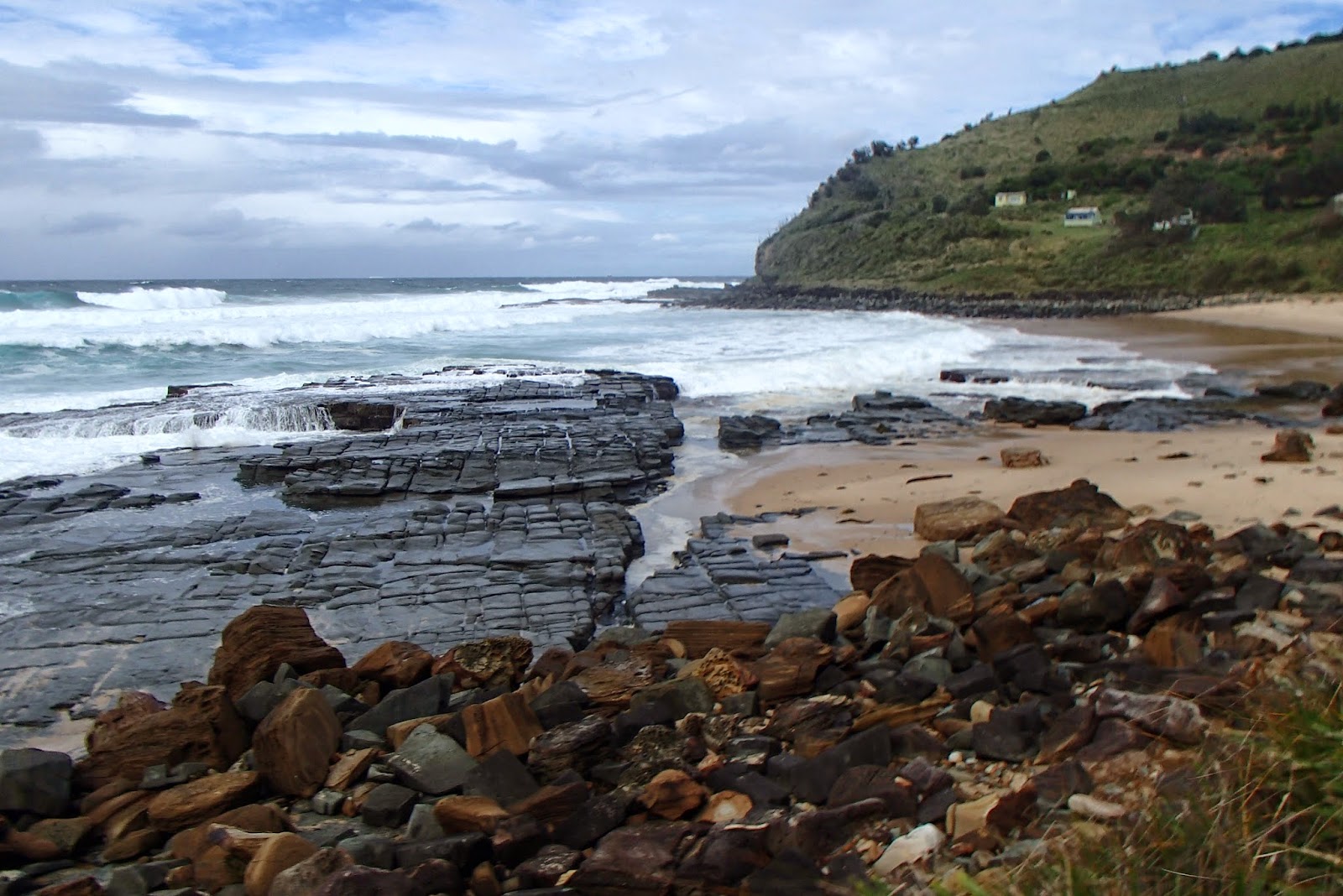
The glorious view from Garie Beach on our previous (much more temperate) visit.

We huddle against the wind and I make my introductions as my filial and social worlds collide, milling about a picnic table while we wait for all the attendees to arrive. We are surprised by how many people show up, perhaps a couple dozen: active middle-aged couples in hiking gear, a young migrant family with an adorable baby, and the various other pleasant, solitary grey-haired oddballs you find at such events, enthusing politely and asking earnest questions like garrulous mature-age students at uni. My friends and I are conspicuously the youngest adults there, later earning us the moniker of 'the young ones' from the event coordinator Kerry, who soon makes herself known and leads us on a narrow path towards Little Garie nestled between the cliffs on one side and the beach on the other.

Family: Nan, Eddie, and great aunt and uncle Christine and Stewart bringing up the rear. The 'most accessible' though it is, all the materials that comprise and fill the shacks of Little Garie would have to have been carried along this narrow path, including the heavy old kerosene fridges and cast-iron fireplaces.

The view from the track, with the rocky plateau where the shackholders meet for elevensies in the foreground and some of the Little Garie shacks beyond.

Warm and quick to laugh, Kerry strikes me over the course of the day as the most socially conscious of the guides, trying visibly to keep speeches from her fellow guides on track, forewarning us of the more notoriously loquacious shackholders and hurrying along any groups that linger too long in any one dwelling. She guides us up a steep hill, which she assures us is the only one we will need to contend with, to the characterful Little Garie community hall and chapel, where we are to meet the rest of the guides and residents: Tim, Peter, James, Gary, Tony and more. I didn't take any photos on this occasion, but I did take some during the 2013 visit:


Kids playing with a kart outside the hall.

In the hall we learn that the first shacks in the area were holiday cabins built from 1910 onwards on land rented from the owners, forty years before its incorporation into the National Park. Later during the Depression, the communities swelled as unemployed miners from nearby Helensburgh moved into the area. Once the land was resumed in 1950 after lobbying from the shackowners to protect it from property developers, no new shacks were permitted to be built. The existing shacks could, however, still be bought and sold until the mid-1960s when the land came under the governance of the newly formed National Parks and Wildlife Service (NPWS), whose policy was to remove the shacks once their owners died. This led many families to just continue paying rent under the pretense that their deceased relative was now a decagenarian. Nevertheless, the NPWS succeeded in demolishing around 50 shacks during this time. Apparently the removal of the shacks ranked in the top two things former NSW premier Bob Carr wanted to get rid of during his time in office, during the same time heritage authorities were clamouring to protect them.

Today the shackholders are council workers, medicos, PhDs, engineers, sugarcane farmers, coal miners and all manner of other professions. Indeed, one of the most distinctive shacks we would see, brimming full of fantasy novels and half built of stones that leak when it rains, is cared for by a kindly Woolooware High School science teacher/archaeologist/Egyptologist. Each shackholder pays circa $3,000 a year in rent, and they are entitled to have up to four names on their leases. Very few of them live in the shacks fulltime, but they visit frequently on weekends and stay for long periods over summer and during winter holidays. The custodians of such a prized coastal idyll might be expected to guard their closed community jealously against outsiders, but the open day shows their attitudes to be the opposite. In fact, it is due to their efforts to the contrary, largely exercised through the Royal National Park Coastal Cabins Protection League (RNPCCPL), that the NPWS' policy of shack removal has latterly been overturned. The communities' demonstration and celebration of their unique cultural heritage has led to its recognition by several various heritage authorities, and the open day itself, we are told by bright, eloquent RNPCCPL president Helen Voysey, commemorates the listing of the communities on the State Heritage Register in 2012.

The promulgation of the shack communities' culture being one of the goals of the day, the shackholders are eager to impress upon us the importance of the shacks in their lives. 'We're very heartfelt. These aren't just some place we come and have fun, stresses Kerry. 'These are a part of our structure, our DNA.' She also emphasises the intimacy of the Little Garie community, noted among the four for its closeness, citing how quickly secrets spread among the shackholders, and their daily ritual of elevensies. Another community member adds that there are regularly five generations in a shack, and Helen concludes that 'Heritage is not just your big stone buildings and your government houses; it's your little shacks where people survived the Great Depression and where people carry on a kind of holiday recreation life.'

Another point to which the shackholders continually return is the effort involved in maintaining their seaside escapes. Possessed perhaps of an ingrained sensitivity from the parlous state in which the shacks existed for such a long time, they seem to want to prove that it's not all just the bucolic retreat and pleasant weekends surfing and fishing in the sun that visitors might think, that it's not only through the luck of birth or marriage that they come to enjoy their shacks, but that they have earned the privilege through their hard work preserving and maintaining them. Peter characterises the task as a fulltime job, battling the wind, storms, and vandalism. Their $3,000 a year is the price for the location alone; it doesn't buy them the amenities, roads, pathways, infrastructure the ordinary taxpayer expects, nor the community services ratepayers enjoy, nor the upkeep on which ordinary renters can depend. The shackholders seem to do most of this themselves. They constructed the stairway we trudged up to reach the hall, Kerry told us, when the NPWS wouldn't pay for it and visitors kept injuring themselves. My friends and I happened to be there that day on our previous trip as the men sweated, heaving rocks up from the river to sink into the earth as platforms to stand on. I even recognise some of the shackholders in the hall as the smiling faces of people who greeted us and wished us well as we passed through that day, giggling in their swimmers with champagne glasses in their hands.

One of the shackholders carries a stone up the hill to use in the construction of the stairs.

Throughout the day we would be regaled with such tales of the shackholders' diligent ingenuity and resilience, from the construction of the stone shack from boulders rolled down from the hills above to its more recent repair when the roof blew off in one piece. Fences have been erected to prevent rockfalls and protect and hold back plant species. Days have been spent clearing the brush of the decades worth of shattered glass from the beer bottles of the shackholders' antecedents. An agreement was made for the community to take over the upkeep of any shack whose owner grew too old to maintain it themselves. And then there is the shacks' most persistent enemy: whiteants.

Some of the shackowners of years past were more creative in their bottle disposal methods. Each of these show their brewing year on their base, some dating back to the forties and fifties.

We are informed the floor we are standing on in the hall has just been replaced for fear that it wouldn't hold up underneath us after whiteants (or termites) had been at it. The first shack we are led to in our smaller group, in fact, is a thoroughly comfortable and modern-looking, caravan-style dwelling which owes its contemporary feel to its previous degradation by the voracious little insects. The shack belongs to Tony, a friendly bloke jokingly referred to as a 'blow-in' for his measly two decades in the community who was invited in when the former owner of his shack was no longer able to care for it and had no willing heir to take up the responsibility. Tony restored the shack and, in the process, added a few mod-cons. The internal bathroom is tiled, the walls are smooth and a TV plays a DVD about shack life in the background.

Tony speaking to us in his 'beach shack'. Many of the shacks feature these little signs, which in another context might be considered tacky – cheap, mass-produced knick-knacks hawked by imitation-high end homeware stores to ironically adorn the holiday homes and beachside investment properties of affluent city-dwelling bourgeoisie. But somehow I think the shackholders are more entitled to make use of them than these usual purchasers.

The contemporary style of Tony's shack represents another theme that permeated the day. Kerry has encouraged us to ask questions of our guides, saying, 'They're passionate about their shacks and their ideas'. In the way of so many people who lead eccentric lifestyles, who harbour some desire to retreat from ordinary life, whether innate or bred into them by a lifetime of shack holidays, many of the shackholders seem to have eccentric or strongly held views. Of course, I only had a few hours contact with them, but even in that time I feel I was able to detect a few of these unguarded opinions, which seeped into the conversation at any opportunity, the way we vegetarians wait for any vague allusion to meat-consumption to pounce on. Kerry and the others hint laughingly a few times at the strife that arises between community members occasionally, as with any family, saying she thinks it's what makes them so close. One of the divisions I pick up on is between those who have updated their shacks and the purists who 'don't like the modernisation of the shacks' and prefer 'to keep them as humble as what they were when our parents had them', in Kerry's words.

Tony, I think, may be omitted from this mild resentment because his was a restoration of necessity, but when she takes us through her shack, passed down from her husband Gary's parents, Kerry remarks that some shacks even have Foxtel, adding, 'We ain't going down that path!' Later in the last shack we'll see we are astounded by the decorations. Books line every ledge and splay over every surface (I'm impressed by the presence of Winton and Dawkins). Entire walls are covered in patterns formed from wine corks, which seems a local fashion, while others are plastered with photos depicting festive evenings on the grog with not a few bared breasts and bottoms. Snake skins and cicada shells dangle from the rafters, dead sea animals hang in the windows, along with paraphernalia of every other kind scattered everywhere: a Navy sailor's hat that washed up on shore, artwork by the grandkids, ancient photo albums, a telescope. Awed as we enter, the owner says pointedly, 'Yeah. This is a shack. A real fisherman's shack', as if in distinction from the less authentic modern shacks that surround it.

This shack was the most exciting to me because my hermit protagonist's shack is similarly brimming with the objects he collects, and ideas were rich for the harvesting here.

All this conjures the image of a secret Little Garie cabin elite who behind closed doors thumb their noses at the unenlightened shackholders turning their abodes into the holiday-home equivalent of McMansions, and I tend to sympathise. Certainly the most unchanged old shacks are the most fascinating, both for my friends and me as a window into the past and as nostalgia for those of the older generation in attendance. Nan lights up when we enter one old shack with a hand-wound laundry wringer out front, still furnished in the old style within. Other people seem more interested in these older-style shacks as well  this shackholder proudly shows us the magazine article in which he featured, and Kerry tells me a Tropfest film was shot there last year.

Another strong and not-so-hidden view that pervades the community is a lingering contempt for the NPWS, understandable given the historical animosity between them. Helen describes the history as a pendulum swinging, and expresses a hope that one day it will eventually stop somewhere in the middle. At first the authorities liked the shacks, she says, because they wanted the revenue. Then the pendulum swung and the idea that national parks would be without people rose to prominence, before it swung back to recognise the value of human heritage. (It occurs to me that this is much more elegant and obvious metaphor for my 'stratigraphy of argumentation', which I later learned was an unconscious permutation of the Hegelian dialectic). Ever the PR liaison, Kerry speaks frankly about the rift but ends on a decidedly hopeful note, saying 'we're starting to get on an even footing now', only to be undercut by a more embittered community member who adds, 'Well, some of us are' in what is just one many veiled and unveiled digs at the (older) rangers and the NPWS throughout the day, and not without reason. In the hall after thanking us for our interest in the valley Kerry tells us it is 'important for us to get out our history, as in, the truth, let's say, not a skewed version.' We are told about one ranger who still works at the park who allegedly sunk an axe into a kerosene tank and, when asked why, reportedly answered 'So you bastards can't use it.' When bushfires swept through the region and the community evacuated, they came back to find the words 'Burn you bastards, burn' scrawled on their blackboard, supposedly by the same ranger.

The other strongly held beliefs of the community appear to be environmental. Kerry points out that the community has been forced to abandon their kerosene fridges for high-tech solar ones due to the unavailability of parts. We are introduced to at least one 'solar nut' and his solar-powered shack, as well as Peter, an affable 65-year veteran of the environmental movement, whose shack was one of the last legally bought Little Garie shacks . An engineering consultant by trade as well as a Landcare volunteer, Peter seems to be the resident historian of the community, claiming to have spent a lot of time researching to determine that the Royal National Park shacks are absolutely unique in Australia as non-road accessible coastal cabins built legally on freehold land. He distributes flyers about the communities entitled 'Living Heritage'. 

Peter's experience of the environmental movement is fascinating. It must be bizarre to have been in a movement from its inception as a fringe concern and watch it ascend to mainstream acceptance. 'I can assure you it was not very popular,' he says in the hall. 'You were considered to be a Grade-A screaming nutter'. This is a pertinent example of our tendency to underestimate how much things can change in one lifetime, and a reminder not to measure the worth of ideas by their extremity in relation to the current norm, but on their own merits. In sixty-five years there will likely be an entirely new norm that may embrace what once seemed radical. 

Peter's shack.

Peter.

Before Peter speaks in the hall we are jokingly warned not to ask him about climate change. He goes on to say that the environmental movement has been 'hijacked by radical nutters who really don't understand the issues'. He may have a point and his example of the protests against hazard reduction burning is hard to argue with, but I found myself hoping this friendly and knowledgeable figure wasn't a denier of anthropogenic climate change, although the warning not to ask him about it could be interpreted either way.

The tour over, the various smaller groups reconverge on the hall for the sausage sizzle the shackholders are putting on. Alexandra and I duck back to the car to retrieve our Eski full of a vegetarian feast and sit in the grass a short distance away, attracting gratifying comments from various passersby that they're jealous of our lunch. A Little Garien hawking raffle tickets offers me the 'lucky ticket' 69 (appropriately the one from the shack featuring the lewd photographs) and I purchase some giftcards featuring paintings, photographs and drawings by a local artist to add to the nascent wall collage next to my desk to inspire me. Meanwhile, Charlene prompts my nan to buy me a 'Shacks Forever' shirt by pretending I told her I really wanted one.

I thought myself lucky to find the two paintings of the swamp wallaby, as one significant section of my novel revolves around one such wallaby who lives in the park.

After that the weather finally gives out and the rain drives everyone back inside the community hall. Fearing that the locals would take issue with an outsider coming in to tell their story for them, I was hesitant to mention the novel to anyone. My nan, however, fearlessly informed both Kerry and Helen, who thankfully responded with nothing but polite enthusiasm, obligatory though that may. But I'm glad, because it got me both some tantalising traces of stories to follow up on, some regarding the real hermits who inhabit the national park, as well as some great contacts, especially Helen, who welcomed me to contact her when I needed more information, something I will definitely be doing when the time comes. I'll also, I'm sure, be making many more journeys to the National Park to continue learning about the extraordinary communities to be found in this place which is so central to the geography of my life. And maybe when I do, at Charlene's suggestion, I'll be wearing the shirt Nan got me. 

Shacks forever!


Thanks for reading

LPL

Note: If anyone depicted visually or textually in this post wishes their name or image to be omitted, please contact me. Feel free also to contact me with any questions, corrections or complaints.

Monday, 16 April 2012

Cloud atlas and the left

Monday 16 April 2012

I'm quite short of time at the moment (one assessment due tomorrow, one on Thursday, three books to read this week, editing work needed for Wednesday, going to Melbourne for the comedy festival from Thursday to Monday, with a presentation on a book I haven't started reading due two days after I get back), so in lieu of a real post, here's something I've been meaning to put up here for a while that won't eat too much into my time.

A while ago, while Til and I were travelling around Italy and Greece, I read a wonderful book by David Mitchell called Cloud Atlas, which was shortlisted for the Booker Prize in 2004 and which was recommended to me by one of my lecturers, the excellent Dr Joshua Lobb.


I'm increasingly interested at the moment in tracing back the texts and ideas I encountered that led me to certain conclusions, because sometimes my conclusions (eg socialism, vegetarianism) seem so radical when just looked at bare. But if I could present people with a more manageable sequence of ideas that, once accepted, lead to that conclusion, it might be more understandable.

The book is full of beauty and poignancy, but in particular the passage I want to quote below, the ending of the book, when read after undertaking the journey of the entire novel, was one of the first things I encountered that led me to start thinking about why a progressive, leftist, socialist (look it up if that sounds alarming; it might not mean what you think it means) approach to world governance is a better one than a conservative, capitalist, individualist one. I now see the divide between left and right as largely one of cooperative socialism and competitive individualism. It even had a part to play in the development of my ideas about vegetarianism (note the 'weaselly word' the narrator identifies, and possibly see my post ''Naturalness', semantic decay and veg(etari)anism (part two of three)').


And don't worry, it doesn't have much in the way of spoilers, although being the final passage there are a few references you obviously won't understand if you haven't read the book:

Scholars discern motions in history & formulate these motions into rules that govern the rises & falls of civilizations. My belief runs contrary, however. To wit: history admits no rules; only outcomes. What precipitates outcomes? Vicious acts & virtuous acts.

What precipitates acts? Belief.

Belief is both prize & battlefield, within the mind & in the mind's mirror, the world. If we believe humanity is a ladder of tribes, a colosseum of confrontation, exploitation & beastiality, such a humanity is surely brought into being, & history's Horroxes, Boerhaaves & Gooses shall prevail. You & I, the moneyed, the privileged, the fortunate, shall not fare so badly in this world, provided our luck holds. What of it if our consciences itch? Why underminde the dominance of our race, our gunships, our heritage & our legacy? Why fight the 'natural' (oh, weaselly word!) order of things?

Why? Because of this: – one fine day, a purely predatory world shall consume itself. Yes, the devil shall take the hindmost until the foremost is the hindmost. In an individual, selfishness uglifies the soul; for the human species, selfishness is extinction.

Is this the entropy written within our nature?

If we believe that humanity may transcend tooth & claw, if we believe divers races & creeds can share this world as peacably as the orphans share their candlenut tree, if we believe leaders must be just, violence muzzled, power accountable & the riches of the Earth and its Oceans shared equitably, such a world will come to pass. I am not deceived. It is the hardest of worlds to make real. Tortuous advances won over generations can be lost by a single stroke of a myopic president's pen or a vainglorious general's sword.

A life spent shaping a world I want Jackson to inherit, not one I fear Jackson shall inherit, this strikes me as a life worth the living. Upon my return to San Francisco, I shall pledge myself to the Abolitionist cause, because I owe my life to a self-freed slave & because I must begin somewhere.

I hear my father-in-law's response. 'Oho, fine, Whiggish sentiments, Adam. But don't tell me about justice! Ride to Tennessee on an ass & convince the red-necks that they are merely white-washed negroes & their negroes are black-washed Whites! Sail to the Old World, tell 'em their imperial slaves' rights are as inalienable as the Queen of Belgium's! Oh, you'll grow hoarse, poor & grey in caucuses! You'll be spat on, shot at, lynched, pacified with medals, spurned by backwoodsmen! Crucified! Naïve, dreaming Adam. He who would do battle with the many-headed Hydra of human nature must pay a world of pain & his family must pay it along with him! & only as you gasp your dying breath shall you understand, your life amounted to no more than one drop in a limitless ocean!'

Yet what is any ocean but a multitude of drops? (527–529)

Incidentally, there's a film adaptation of Cloud Atlas coming out late this year with Tom Hanks, Halle Berry, Hugo Weaving, Susan Sarandon, Jim Broadbent, Hugh Grant and Jim Sturgess, so get your hands on a copy and read it beforehand!

LPL

References
David Mitchell's novel Cloud Atlas, published in 2003.

Cover image.

Wednesday, 21 March 2012

Anthropocentrism and the sentience hierarchy (part three of three)

 Wednesday 21 March 2012

This post originally formed part of my other post, ''Naturalness', semantic decay, anthropocentrism, hierarchy and veg(etari)anism (part two of two)'. Upon rereading it shortly after I first posted it, I decided it was really a separate issue and could be excised to make that post more readable. I hadn't gotten around to reposting it yet, so this is it, part three in my series of posts about veg(etari)anism.

In 'Miranda devine: enemy of the heart, the mind and vegetarianism' I argued that one of the central positions of Devine's piece – that we may as well eat meat because even if we only eat plants, we are still causing pain and death – was flawed because, among other things, it assumes that there is not a hierarchy in the capacity for suffering of different forms of life.
Positioning sentience as the sole criterion for valuing life is not without its problems. Viewed from the most objective, abstract perspective practically imaginable – say, that of an omniscient gaseous cloud which gained mass somehow from the dream of a fictional character imagined by a germ on the forehead of an alien* – it's arbitrary, biased, and it doesn't take into account forms of sentience we don't understand. But it's really all we have to go on. Like many things, it's an imperfect starting point, unstable ground upon which we have no choice but to build our more reasonable, moral theories.

*Suggestions for further abstraction welcome. 

Life is intrinsically valuable, but we can discriminate between the relative values of its different forms on the basis of sentience – the capacity of a lifeform to experience pleasure and pain, to have a 'preference', as Peter Singer explains in Animal Liberation, which David Foster Wallace calls 'more or less the bible of the modern animal-rights movement':

     It would be nonsense to say that it was not in the interests of a
     stone to be kicked along the road by a schoolboy. A stone 
     does not have interests because it cannot suffer. Nothing 
     that we can do to it could possibly make any difference to its
     welfare. A mouse, on the other hand, does have an interest in
     not being kicked along the road, because it will suffer if it is.

Others have argued that all life is irreducibly and equally valuable. The system of reasoning I'm outlining, however, contends, perhaps less radically, that human beings come out on top. Our lives are the most valuable and the most important. But there's a crucial distinction between the reasoning that brought me to this conclusion and the reasoning used by others that privilege human life over animal. If you've read my blog post, 'Positions on political correctness: towards a stratigraphical model of argumentation', which you almost certainly haven't, this situation might sound familiar. We have the base Position containing all those traditional justifications humanity gave itself to do whatever it wanted to animals – man is greater than beast, God gave men mastery over animals – which has been countered by the Position asserting universal equality of life. My Position seeks to occupy a third stratum paradigmatically above the other two, but syntagmatically between them. The 'mastery over animals' Position condones any violence that humans wish to enact upon animals, and the 'irreducible and equal value of life' one allows none, but mine (and many others') justifies the taking of animal life only when there is a direct choice between animal and human life: when, for example, a human must eat an animal to survive, or when an animal attacks a human.

The effective distinction between the three arguments, then, can be found in the points at which they locate the justification for the taking of animal life on a scale of necessity. Under Position 1, it can be almost anything – nourishment, pleasure, entertainment, convenience. Position 3 locates the distinction at a point beyond all of these, making them all violations of its rule, but some more extreme violations than others.

It takes a lot for me to dismiss the death or pain of a fellow human being, considering the importance I place on empathy as a characteristic, and it's usually the kind of thing I cringe at when I hear someone else do. I've found one exception, however, to be when humans kill animals for reasons that constitute more extreme violations of Position 3 and are themselves killed or injured in the process, as, for example, happened earlier this year when a hunter accidentally shot a protected grizzly bear thinking it was a black bear, or as occasionally happens to Spanish bullfighters:

Gustavo Cuevas's World Press Photo award–winning shot of matador Julio Aparicio being gored in the throat.

When a human is injured in this way, I can't help myself thinking good on the animal that did it. And no matter the sympathy I have for victims' families, my reaction is usually at least 'fair enough' when a person is killed in this way. If humans breed animals specifically for the purpose of killing them needlessly, or if they go into the animal's habitat with the same intention, and the animal is able to overcome the significant odds stacked against it, I simply can't help applauding it. It's not unlike the response evoked by the death of a mass murderer: certainly nothing like the mindless, morbid delight of the celebrations that ensued upon the death of Osama Bin Laden, but nevertheless a calm sense that justice has been done (in this light, another justification for killing a sentient being might be added to the argument – punishment for undoubtable, confessed, wilful, unrepentant mass murder of humans or other equivalent beings on the sentience hierarchy, by a human or other equivalent being on the sentience hierarchy).

The interesting and somewhat disturbing corollary of the sentience hierarchy as I have described it is that, if Earth was colonised by a race of aliens more intelligent than us, it would be morally acceptable for them to eat us if it came down to a choice between that or starving. The only defense would be an addition that asserts that the hierarchy plateaus at a certain level of intelligence, and all species beyond that point are equally as important as one another in spite of any differences in intelligence, and it is therefore universally wrong to kill any of them. But it would be fairly convenient to locate this plateau just below humans in the hierarchy. You'd at least have to include the great apes and the higher-order sea mammals, but humanity's actions hardly accord with this inclusion considering the damage we do to the habitats of both.

Which is unsurprising considering humanity's overall hypocritical, anthropocentric attitude to predation. You only have to look at popular culture television shows and films to see that we regard anything that hunts us as evil, but anything we hunt as an acceptable source of food. In Dragon Ball, Goku hunts wolves and giant fish, but dinosaurs and even other humans who hunt other animals are characterised as villains and are consequently attacked by the morally incorrigible protagonist. The same hypocrisy can even be found in Buffy the Vampire Slayer. It's okay for Buffy to kill vampires and demons because, 'They're evil'. Why are they evil? Because they eat humans and they have no souls. But why discriminate against creatures just because they have no soul? They can't help it. They're just as intelligent as humans, and the show demonstrates they have the capacity to suffer, but killing them is acceptable because they need to prey on humans to survive. In this respect they're more moral than us; we eat animals even though we don't need to, but a vampire can subsist on nothing but blood (although pig's blood is a viable, more conscionable option for the program's re-ensouled undead). But stay your hands, Whedonites. I hasten to add that, to be fair, the show does engage with the Slayer/killer opposition.

'Yeah, I prefer the term 'slayer'. You know, 'killer' just sounds so ... Like I ... paint clowns or something. I'm the good guy, remember?'

References

Gustavo Cuevas's photograph, 21 May 2010.

Marti Noxon's television episode 'Buffy vs. Dracula', from Joss Whedon's television series Buffy the Vampire Slayer, Season 5, Episode 1.

Peter Singer's book, Animal Liberation, quoted in David Foster Wallace's essay, 'Consider the Lobster'.

David Foster Wallace's essay, 'Consider the Lobster', in Gourmet Magazine in August 2004.

Tuesday, 22 November 2011

'Naturalness', semantic decay and veg(etari)anism (part two of three)

Tuesday 22 November 2011

Note
In part one I deconstructed the arguments against vegetarianism and vegetarian Michael Kirby made by Miranda Devine in her article 'Everybody hurts but we've all got to eat'; part two responds to this article with my own ideas about eating meat.

I'm a newcomer to the whole veg(etari)an discourse, and the more I read into it, the clearer it becomes that I have little original to add to the discussion. But I made a decision a while ago that whenever I came to a point of indecision between speaking my mind and remaining silent, I would take the path of expressing myself, out of a belief that it is always better to say something than nothing, to act rather than not. That, and it can't hurt to restate sound arguments often made but rarely heard, to add your voice to a growing chorus. And so I persevere in the face of superfluity ...

The problem of 'naturalness'
The most common argument I hear justifying flesh-eating is that it's natural, an argument that I think can be split in two. The first of these holds that we have evolved to need meat, we are designed to eat it, and therefore we must continue to do so if our bodies are to function properly, the same way a lion cannot choose to give up eating meat because its body simply would not support a diet of any other kind. I believe this argument is factually untrue. Perhaps for the first time in our history, our technological and dietary knowledge is at a level where we can quite healthily live without eating meat (and it's looking better for the future, as well; the concept of laboratory-grown meat incites a kneejerk rejection and a shudder from hippie organic-enthusiasts and hearty meat-eaters alike, but I look forward to the guilt-free meal as long as scientists can convince me there's no harmful side-effects). Of course, meat is a very efficient way of gaining certain things that our bodies need, but it is not the only way. Is efficiency really a good enough reason for taking an animal's life? As for our being designed to eat meat, the physical similarities between humans and herbivores, along with the physical differences between humans and carnivores, have been well-documented. The evidence indicates that we were herbivores who opportunistically became omnivores, not carnivores who became omnivores. And our meat consumption today far exceeds anything we would have eaten in our evolutionary past. Meat would've been a rare addition to our diet, nowhere near the staple it is for many people today (Colleen Patrick-Goudreau).

The second argument under the 'naturalness' umbrella is not practical but moral: we evolved to eat meat, therefore it's okay – an irretriveably mixed-up bit of reasoning, to adapt a phrase from Rohinton Mistry. When does 'naturalness' ever guarantee that something is moral? People can and do justify all sorts of ridiculous positions with the argument that 'it's unnatural' (ahem, opposition to gay marriage), but even if not eating meat is unnatural, this is still a thoroughly flawed argument. So is everything we do in contemporary society. Medicine? Birth control? Abstinence? Monogamy? Technology? Supermarkets? Yep, all totally unnatural. I think vegetarian comedian Wil Anderson said it best in his show at Splendour in the Grass this year, when he posed his response to the argument, 'It's unnatural not to eat meat; even animals eat other animals – look at lions'. I paraphrase:

      Do you get all your ethical opinions from lions? What else do you
      do like lions? Do you sleep twenty hours a day like lions? Do you
      have a spiky, barbed penis like a lion? Do you sell Paddle Pops for
      a living like lions? Do you live in a wardrobe with a witch like
      lions?

I'll come back to the issue of naturalness in the next section, but first, if there's any proof that I'm not some closed-minded bastard who has set opinions on every issue and will never change, as I was discussing in ''... So openminded that our brains drop out'', it's my attitude on this issue. I used to be a devoted carnivore and in actions, I still am. I love meat. I absolutely love it. I'm obsessed with food, and meat is one of my favourite kinds. So until very recently, whenever the issue of vegetarianism would come up, I'd scoff. I'd look at my vegetarian friends and family in bemusement. How could they possibly forgo the original carnal pleasure? I thought the idea was absurd. Even animals eat animals, me and my other carnivorous friends would say to one another. We're designed to eat meat. Animals are dumb. Anything to justify my love of meat and dismiss the points raised by vegetarianism. This, my friends, is the working of ideology. If you ask why something is okay and the best answer you can come up with is that it's natural or normal, that's probably a good indicator that ideology is at work. 'Ideologies try to hide the contingent nature of thoughts and activities within a culture' say Tony Schirato and Susan Yell. '[T]hey try to convince their audiences that certain values, ideas and activities are more or less natural, and that things have always been this way, or should remain this way.'

It takes a lot of thinking to undo ideological indoctrination, to challenge what people not only enjoy doing, but also what they have always been told is normal and natural, and what they see everyone else doing all the time. Perhaps this explains why, if you ask people why they do or don't eat meat, the don'ts seem generally to have more well-thought-out answers, because the only way they became don'ts in the first place is by observing and formulating reasons not to eat meat. The dos, conversely, tend to eat meat because they always have, and their answer is likely to reflect this reason. '[I]t's okay because we're the top of the food chain' is one answer I got when I asked my friends. In other words, it's okay to eat meat because we can. Or because we do. Contrast this with an answer from another friend, Matt Wheeler:

     I don't eat meat because it is a huge contributor to climate change;
     because it makes grain and other staples more expensive for the
     poor; because it takes huge amounts of water for a single serving
     of meat; because there isn't enough farming land to go around
     and meat takes 16 times as much land as vegetables to grow; 
     because factory farming is disgusting; because pigs are one of 
     the top ten most intelligent animals in the world; because 
     vegetarian food is easy and delicious; because vegetarians live 2 
     years longer on average than those on a typical western diet; 
     because I think 'stewardship' means 'look after' not 'take 
     advantage of'; and because I think it is always better to have 
     more empathy than to close one's eyes to the pain of others.

Desensitisation and semantic decay
What started us eating meat was, I assume, need. We haven't always been able to be selective about what we eat, and we couldn't deprive ourselves of such a rich source of nutrients. Nowadays I think it's less to do with desperation and more to do with desensitisation. Eating meat seems acceptable because we eat meat already, because everyone does it. This is what I call 'semantic decay': repetition eventually saps the meaning out of any practice. It's what causes the meanings of words and phrases to drift away completely from their original meanings without our notice as we get used to them. It's what makes religion such a poor conductor of morality. Once-moral instructions can eventually become mere empty rituals, self-enforced upon pain of eternal damnation, devoid of any personal emotion or conviction. Under religion, it is entirely possible for someone to feel guilty about saying 'Oh my God', but not about being complicit in a system that slaughters billions of animals a year, usually after they've led awful lives.

We can observe a kind of trend in semantic decay. The older the religion, the culture, or cultural institution and, therefore, the more repetition that has occurred, the more divorced meaning is from action. Perhaps this explains Miranda Devine's inability to comprehend Michael Kirby's point of view. I can't think of a culture in which there is more evidence of rampant semantic decay in the area of attitudes towards a kind of animal than Japan's, where Devine grew up. 'Fish died in abundance for the Japanese diet', she says in her article, and they had to. Japan's mountainous terrain being unsuitable for agriculture, it had to turn to the sea. If it hadn't, its people would have starved long ago. But it doesn't make it any easier for the non-desensitised to watch.

Everything I am about to say, I fully acknowledge, is a generalisation, but generalisations can be useful. To the Japanese, anything that lives in the ocean is just food. There's the whaling, of course, but then there's also the annual Taiji dolphin drive hunt, where dolphins are driven into a netted cove and slaughtered en masse, literally turning the sea red with blood.

From the documentary The Cove.

I've seen a Japanese vendor chase an octopus in a netted bag across a cement market floor as it tried to escape. I've seen Japanese chefs in a production line tearing out the eyes of live fugu (pufferfish), chopping off their tails and fins, shucking their elastic skin off over their heads like jumpers and tossing the mutilated fish, blind, bloody and gasping, into an industrial-sized bin of their already-expired companions. I've seen a Japanese diner pick a fish out of a fake, in-restaurant pond, then light up with glee when that same fish is brought out on a plate as sashimi, its uncooked flesh flayed out in a fan of wafer-thin slices, its body wrenched at an unnatural angle, its mouth sucking for air and its body twitching as its flesh is torn with chopsticks from its body.

'Give it to us raw, and wriggling.'

Now fish are not highly intelligent creatures, but that right there on your plate is a living organism with the capacity to feel pain, and it is suffering for no good reason. It's just sick. My personal aversion to seafood is mostly mental, a relic from my childhood that I know I could probably rid myself of if I wanted to. And for a while I did. It's socially debilitating to be picky, and it's looked upon as immature, so I planned to make myself get over it, but now I never will. What we're doing to the oceans is too terrible, and the world doesn't need one more fish-eater. Even caught and prepared in the usual way – by trawlers at sea, dead and cooked – a fish has to suffer too much to get to my plate. There's no quick way to kill fish caught en masse.

'As we become increasingly alienated from the sources of our food,' says Devine in her article, 'childish squeamishness is in the ascendancy'. In other words, those of us who don't want to eat meat are squeamish children. Thanks, your bitchiness (how do you like it?).

But aside from deploying Devine's own stunning rhetorical tactics against her, I really think she's got it the wrong way around. It's not that we're gaining childish squeamishness; it's that we're losing our heartless desensitisation. In the past we've needed to be desensitised to animal suffering in order to survive, and today people who make a living in the meat industry still need this desensitisation, but the rest of us, 'alienated from the sources of our food', are beginning to bring our attitudes towards animal welfare into line with our modern moral outlook. Predictably, being the enemy of the heart and mind that she is, the conservative Devine instinctively rejects this impulse, this change in the status quo. But I believe we should embrace it, as difficult as it is.

Returning to the issue of 'naturalness', those who justify their continued consumption of meat with that argument must consider this impulse. If it is natural for us to eat meat, then it is equally natural for us to feel squeamish about doing so, and the evidence is in our actions. Yes, our mouths water at the smell of sizzling bacon or roasting beef, but even Devine admits 'most people feel sadness at the death of animals'; we flinch when we see it actually happen. Just look at the rituals of penance and reverence codified into early cultures, which insisted on prayer after the killing of an animal, thanking it for giving its life – an attempt to absolve guilt if ever there was one. Kirby points to the packaging of meat, which allows us to think of it as the 'impersonal products of sterile, clean supermarkets' and of eating it as 'hygienic and somehow depersonalised. Or de-animalised.' Even the English language and our codes of etiquette enshrine this guilty discomfort: it's considered impolite to discuss the animal you're eating at any given time, or to talk about any graphic part of its preparation. There's something in the way we are so easily put off eating by talk of blood or guts that belies the supposed naturalness of our eating meat. In 'Consider the Lobster', David Foster Wallace points out that 'most mammals seem to require euphemisms like "beef" and "pork" that help us separate the meat from the living creature the meat once was'; we've craftily stolen words from the French to ease our guilt. Who among us can say when they watch a predator of Africa chasing down its prey, that it is not the hunted that they hope for, rather than the hunter? We know, in our logical minds, that it's unfair to favour the gazelle over the lion; the latter has the right to live as much as the former, but we know that if the lion doesn't get its way it will only go hungry; if the gazelle doesn't, it will die a terrifying death. If you can watch a zebra being brought down by a cackle of hyenas who, unlike lions, do not kill their prey before they begin eating it, without desperately wishing they would just end the zebra's suffering, there's something wrong with you.

The fact is, though, that almost everything we do, we do in spite of nature and the cruel ferocity of the natural order, not because of it. Evolution, when understood properly, is fascinating; both a beautiful and a terrible system, elegantly simplistic in its mindless, ruthless march onwards, propelled by death at every turn. And while evolution will continue to work in different ways on humanity, we have transcended it in many ways. Society operates to a large extent outside of evolution and against it; in so many ways it is cooperative, not competitive. Babies are not left on hillsides to die if they are deemed weak. The mentally ill, the physically disabled, the sick, the poor, the injured, the different, are not dispatched as they might be if nature took its course. We can, and should, seek to resist evolution, which is everything our morality is not. This doesn't mean we stand up and decry the hyena as immoral, and start going out and killing hyenas to protect zebras. It's true that there is a natural order* but it's also true that we are the only species on Earth capable of making a choice not to adhere to it. As Kirby says:

     If the human brain historically expanded because humans
     became carnivores, consuming cooked meat around the
     camp fire that encouraged social life among our forebears,
     why should we turn our backs on these existential
     developments of our species that made us who and what
     we are? The answer to that perfectly reasonable question
     is this. The ingestion of so much protein and the expansion
     of our human brain has produced a creature with a
     heightened capacity for moral reasoning.


*Incidentally, a hole in the arguments of those who try to marry the existence of a creator God with the process of evolution, who do not here have their usual recourse to 'free will'. As Paula Kirby (no relation of Michael Kirby's) asks in 'Evolution threatens Christianity', how could an omnibenevolent God ever set in motion such a monstrous process?

Concluding remarks
All that's left is to say a little about my own diet. I'm still eating meat, and a lot of it. You might see that as hypocritical, but I don't. This post has been more about convincing people to admit or recognise that eating animals is wrong rather than that they should give up doing so (although the two are obviously connected), and I don't judge anyone who continues eating meat. A lifetime of delicious meat-based meals and indoctrination doesn't vanish in a day. But I think it's important to be able to use moral reasoning independent of your actions, to recognise that you're doing something wrong even if you're still doing it, rather than just rationalising and justifying your current behaviours. In some ways, I've been thoroughly desensitised. When I look at a piece of meat, even a skin-covered chicken wing or a slab of beef with bones in it, I simply do not see an animal, I see food, and this is the biggest problem for me. But I'm making progress. The other night I was eating a bowl of Tilly's mum's caesar salad and I had a breakthrough (which should not reflect poorly on the quality of the salad; it's delicious). Getting to the bottom of the bowl after all the lettuce leaves had gone, I was left with a wet, stringy conglomerate of pale white chicken meat and bright pink bacon, and as I was shovelling it into my mouth, I was acutely aware that it was animal flesh that I was eating. The sensation was replaced immediately once it reached my mouth, of course, but nevertheless, that was a big step for me, and those moments are happening increasingly. I'm on my way to re-sensitisation.

For now, my plan has been to stop eating meat automatically. Usually when I'm out for lunch or whatever, I'll just grab a chicken sandwich or something, because that's just what I eat, not because I really want it. Now, unless I actively want a meat dish, I'll get the vegetarian option. As I've said before, I'm not sure I'll ever be able to give up meat entirely. I have almost no self-control, and I'm convinced those vegetarians who say, 'Oh that's what I used to say, but I was surprised by how easy it was' just never enjoyed meat as much as I do, or else we're different blood types or something. But strategies like making meat my special option rather than my general one, and another thing I'm trying called 'Meatless Monday', will and in the former case already have made a big difference to how much meat I eat, which has to have a gradual effect on how many animals I cause to die for my selfish enjoyment of their flesh.

Often in discussion of vegetarianism and related issues, commentators talk about how our treatment of animals might be looked upon by future generations, an interesting idea to entertain. In his reasoned, ever self-questioning way, Wallace says, in reference to the Maine Lobster Festival (MLF):

     if you, the Festival attendee, permit yourself to think that lobsters
     can suffer and would rather not, the MLF can begin to take on
     aspects of something like a Roman circus or medieval torture-
     fest. Does that comparison seem a bit much? If so, exactly why?
     Or what about this one: Is it not possible that future generations
     will regard our own present agribusiness and eating practices in
     much the same way we now view Nero's entertainments or
     Aztec sacrifices? My own immediate reaction is that such a
     comparison is hysterical, extreme—and yet the reason it seems
     extreme to me appears to be that I believe animals are less
     important than human beings; and when it comes to defending
     such a belief, even to myself, I have to acknowledge that (a) I
     have an obvious selfish interest in this belief, since I like to eat
     certain kinds of animals and want to be able to keep doing it,
     and (b) I have not succeeded in working out any sort of
     personal ethical system in which the belief is truly defensible
     instead of just selfishly convenient.

I for one can certainly imagine a more enlightened populace looking back on us as we do our own forebears. It's hard not to see the trend developing over the last hundred years, of extending rights to ever smaller segments of the population, starting with the largest demographic, women, and moving through oppressed races, nations, and ethnic groups; then, in recent years, disabled and gay people. Not to undermine the valiant efforts of today's animal rights activists and campaigners, who are seemingly ahead of their time, but might not we, as a society, turn our full attention to animals when we run out of human minorities? Might not the next mainstream social movement be for animal rights?

Part three looks at anthropocentrism and hierarchising life.

Acknowledgements
Thank you to everyone who's taken the time to read this gargantuan post (almost 4000 words) and to my friends for their enthusiastic response to part one, which gave me the motivation to power through and finally finish this. Thanks to Wil Anderson and Lisa Dempster for retweeting it and exposing it to the wider veg(etari)an community, and to everyone else who's retweeted it since. Thanks Sam Glass for directing me to the David Foster Wallace article, and to Alissa for telling me about Colleen Patrick-Goudreau's podcasts. Thanks finally to Matt Wheeler, whose account of why he is a vegetarian was too cogent to resist including; you should all go and check out his amazing, custom, whittled artworks!

References
Wil Anderson's live comedy panel, Wil Does Parky, at Splendour in the Grass, Woodford, Queensland, Australia. Sunday 31 July 2011.

Miranda Devine's opinion piece, 'Everybody hurts, but we've all got to eat', in The Sunday Telegraph, Wednesday 5 October 2011.

Peter Jackson's film, The Lord of the Rings: The Two Towers, by New Line Cinema, 5 December 2002.

Michael Kirby's opinion piece, 'Animals deserve our protection', in The Australian, Saturday 1 October 2011.

Michael Kirby's opinion piece, 'Sense and sensibility about our fellow sentient creatures', in The Sydney Morning Herald, Friday 6 August 2010.

Paula Kirby's blog post, 'Evolution threatens Christianity', on The Washington Post's On Faith forum, 3:26pm 24 August 2011.

Rohinton Mistry's short story, 'Condolence Visit', in his short-story cycle Tales from Firozsha Baag, published by Faber & Faber in 2006.

Colleen Patrick-Godreau's podcast, 'Humans are meant to eat meat. Just look at these incisors in my mouth', from her podcast series Vegetarian Food for Thought: Inspiring a Joyful, Sustainable, Compassionate Diet.

Louis Psihoy's documentary, The Cove.

Charles Rangley-Wilson's documentary, Fish! A Japanese Obsession, by KEO Films, 23 March 2009.

Tony Schirato and Susan Yell's 'Ideology', in Communication and Cultural Literacy: An Introduction, published by Allen & Unwin in 2000.


David Foster Wallace's essay, 'Consider the Lobster', in Gourmet Magazine in August 2004.

Matt Wheeler's private correspondence via Facebook, 10:27pm Tuesday 11 October 2011.