Showing posts with label Book reviews. Show all posts

Tuesday, 23 June 2015

Kate liston-mills’ the waterfowl are drunk!


Monday 22 June 2015


Pambula-based writer Kate Liston-Mills is a friend of mine and a fellow graduate from the University of Wollongong’s creative writing program, where she was a few years older but a few year groups below me. Disarming, ebullient, and universally beloved, Kate is humble to a fault, with eyes so blue they must’ve soaked up all those South Coast seas and skies. As an editor for the annual UOW Creative Writing literary magazine Tide, I remember having the chance to publish some of Kate’s outstanding poetry back in 2010, but page limitations ultimately forced the committee to bump the lowly first-year from the volume, something that never quite felt right to me. Thankfully, if unsurprisingly, Kate’s words have since appeared in publications much loftier and more widely circulated than Tide (and even later editions). But it still felt like something coming full circle when the advance copy of The Waterfowl Are Drunk! appeared in my inbox. A wrong has been righted, and in such spectacular fashion.

The gorgeous KLM.

Published electronically by Spineless Wonders as a Slinkies Under 30s collection, The Waterfowl Are Drunk! is Kate’s first major work. In seven interconnected short stories, she draws from deep wells of truth and fancy to bring to life this heartfelt tribute to town, home and family. Working in the best traditions of the tall tales and urban myths repeated and embellished in country pubs the nation over, The Waterfowl Are Drunk! is a richly rendered and skillful meditation on birth, death and disability in coastal, regional New South Wales.

Perhaps somewhat embarrassingly for a gen-y bibliophile like myself, this was actually my first experience with an ebook, so it was only after some significant fandangling and carnsarnitting with the zoom function on Apple’s iBooks that I was finally able to sink into the collection’s opening vignette, ‘Bound’, which immerses the reader in the teeming wilds of the Pambula wetlands, ‘on the fringes of what some would call a dated town’. 

But this is no Eden, if you’ll excuse the pun. ‘Think red dirt, murky water and tired trees’, the first line enjoins us. The birds swelter in the heat, the ‘stench of rot and fetid water is inescapable’, and in the bushes lurks a dangerous interloper, a red fox. For a moment here I thought I was reading an example of that rarely realised mode of environmental fiction that children’s literature scholar John Stephens calls ‘deep ecology’ – fiction that attributes an intrinsic value to the lives of animals and the environment, often decentering or showing as contingent human perspectives, or excluding them altogether. But the instance of a pen anthropomorphically assigning her cygnets names, as well as the somewhat malapropos simile of a waterfowl slurping a worm ‘as if it were a slushy’, anchors the reader in a human perspective and a roughly contemporary moment, and it soon becomes obvious that what transpires in this wilderness is deliberately symbolic of the human lives we are to encounter in coming stories. 

As with the collection on the whole, ‘Bound’ is not without its awkward lines and, at times, it struggles to maintain focus in its all-encompassing narration, moving abruptly from one group of animal subjects to another mid-paragraph. But in just two-and-a-half pages (depending, of course, on the size of your browser window), Kate achieves quite an affecting narrative in the story of the fox and his victims, cast in suitably raw, fictile language that showcases her poetic credentials and, at its best, recalls the evocative simplicity to be found in the rural poems of Seamus Heaney:

     The cygnets’ eyes, not yet open, are glued with fluid. And through the flurry of
     feathers and calls, the cygnets plop out of the eggs and sog up the earth.

In the symbology of this natural tableau, it is worth interrogating the figure of the fox: is he, as an introduced species, merely representative of a troublemaking outsider, upsetting the rightful order and earning the fear and scorn of the locals? Is he death, an agent of doom against whom the members of the community are able to rally, though never fully prevail? Perhaps, by extension, he is the reader, come to gorge himself on the lives of the town’s inhabitants in the coming pages for his own satisfaction. Or could he be the writer herself – all writers: slinking double-agents moving stealthily amongst unwitting native prey, scavenging for stories and details? The answer, of course, is up for interpretation.


What is established early and unequivocally in this opening story is that Kate’s is a vision of the world where the invisible forces that so often move and shape us, guide and animate us, are made visible, where the abstract and intangible interplay with reality in concrete ways. On occasion here and throughout the collection, this device can veer towards the overly ‘telling’ or convoluted (such as, for example, when we are told that a wind blowing through the town’s streets carries ‘the aftershock of war and soiled youth’), but at others it results in breathtaking passages of Wintonian beauty and eloquence, as when, simply, ‘Ed feels the day approach’ or, later, when the news of Ed’s demise as it travels throughout the town, mobilising everyone into sympathetic action, is characterised as

     tinkering like a mechanic, slowly tapping on each head. It’s tapping into the nuts and 
     cogs of the heart of the machine, tapping each greasy component, until the parts all 
     work together.

Aptly, the concept first treated in this fashion, the ‘sweet nostalgia’ that ‘blends with the croaks and sits on the tilted horizon’ in ‘Bound’, is also the one that most suffuses the work as a whole, which is always romantic and wistful, but never saccharine or overly sentimental. Indeed, what could be levelled as a criticism against another writer becomes in Kate’s hands one of the work’s greatest strengths. Kate shows herself to be an adept conjurer of those moments, sometimes mundane and others extraordinary, that characterise every family history, those universally relatable and yet thoroughly idiosyncratic memories and rituals that form the fabric of a family.

The organising force of the collection is family matriarch Hazel, modelled on Kate’s own grandmother. Prominently featured also is Hazel’s daughter Lottie, a beautiful soul who has Down syndrome, inspired by Kate’s real-life aunt Nettie (to whose memory the book is dedicated). ‘Hey Porter, Hey Porter’ takes the reader to the moment in time over Christmas of 1956 when Hazel is forced to confront her daughter’s disability for the first time. The opening passage, which I count among the strongest in the book, showcases Kate’s skill in tapping into our collective nostalgia in a scene that is both quintessentially of its time and specific filial setting, and yet immediately recognisable:

     The radio is crackling and everything smells of tobacco. The news reporter’s
     carrying on, something about blood in the water at the Melbourne Olympics.
     Nobody’s listening. Hazel has it on so they don’t miss the Queen’s 3pm Christmas
     message. Everybody’s knackered from midnight mass and no one can be stuffed
     cleaning up. The aftermath of Ed’s pig trotter feast is now gelatinous on the sink.
     Flies chinwag in the corners of the trays and stick there. It’s a rotten mess for
     another day.

Later, we find this same skill in ‘I Don’t Even Like Scotch Fingers’, an everyday tragedy where we watch in knowing discomfort as narrator Georgie, distracted by the trivia of teenage existence, takes Hazel, her grandmother, entirely for granted. During one of those familiar interstices in senescent–adolescent conversation, Georgie’s mind wanders to the time they had to rush Aunt Lottie to the hospital because she was choking on a nut, but then they drove over a speed hump and the obstruction dislodged itself, sailing through the air right into her uncle’s hand: just the kind of unlikely, though all-too-real family legend all of us can lay claim to in one form or another.

Just as some stories consecrate the emotional landscape of the family, others do the same for the town of Pambula, most notably in the title story, ‘The Waterfowl are Drunk!’, in which the town reacts to the loss of Hazel’s husband Ed. ‘In Pambula,’ we are told when the death coincides with the arrival of an eccentric houseguest, ‘you have to be hospitable. You just have to.’ Littered throughout the story, attached to the ends of sentences here and there, we find the refrain, ‘as you do’: signposts in the thought processes of the grieving widow that perfectly evoke the double-edged comforting familiarity and stifling oppressiveness of small-town living. Hazel’s actions are governed by a subconscious list of preapproved Things You Do in Pambula, forcing her into the tiresome obligation of indulging the strange old bird who turns up on her doorstep (people are always birds in The Waterfowl Are Drunk!, and birds people). 

But in times of crisis, there is also comfort to be taken from such rituals and ritualised behaviours, as we see with the ceremonies surrounding tea that so pervade the book – the word itself is used some twenty-one times in seven stories (I’m getting the hang of this ebook thing). In ‘The Waterfowl Are Drunk!’ it is this beverage, so treasured by Lottie, that occupies her while the rest of the family tries to shield her from the death of her father. But she is more attuned than her family might think. The sensitive and subtle exploration of the perceptions of different forms of disability that runs throughout the collection is another element for which Kate deserves laudation, executed as it is with the confidence and integrity of a much more experienced writer.

Just as Kate endows Hazel’s family with a canon of folktales and memories, the town too is replete with its own mythology of larger-than-life tales and escapades and, given the distribution of the stories over the course of a century, we are witness to many of them – the misadventures of Ed and Tom on the night Hazel goes into labour, as they rollick around town trying to get their mate’s body to the morgue in the back of a ute and, of course, the tale that gives the collection its title: the time the town drunk disappeared temporarily, only to turn up in a freshly dug grave covered in waterfowl inebriated by the bottle of sherry in his hand. In the telling of these fables we find the blending of comedy and tragedy, that certain mix of beauty, poignancy and irreverence, that marks the best Australian fiction. Which brings me back to the most remarkable element of the collection: the incredible lyricism of Kate’s voice. 

If all literature can be plotted on a spectrum from the spare and sparse on one end to the expressive and ornate on the other, The Waterfowl Are Drunk! would have to be classified ‘hyper-lyrical’, on the far side of the latter. Fans of the Spartan, the reserved, the unadorned sentence, Hemingway devotees and Naipaul adherents alike, be warned. Each of us has our own preferences in this area, and the pendulum of taste seems to have swung back and forth since the inception of the novel, between one school of writers determined to prune back the overgrown grandiloquence and floridity of their forebears, and their own successors, who seek to rejuvenate with inventive, sensual, descriptive writing prose that has come to be seen as sterile and dull. There is a place for writing at every point on the spectrum, but I, for one, tend to prefer the latter kind: writing that gives me something. Writing that’s luscious, that astounds and inspires and tantalises me with new ways of seeing the world. Writing that pushes descriptive language to the limit, that shows me something of the author. Writing like Kate’s.

In The Waterfowl Are Drunk! Kate is a veritable Nigella Lawson of letters, unable to resist tiptoeing down to the fridge after midnight to indulge in one more simile, one more metaphor. And what delicacies she has crafted in this smorgasbord, what moments of descriptive brilliance, masterful details and turns of phrase slipped expertly into the narrative: Lottie picking up the phone ‘gently like a hot cup of tea’, Michael Swaney’s parents with their ‘vegetable-scraps-in-the-plughole-of-a-marriage’, a body ‘fancified’ by bruises and scratches, natal blood ‘soaking into the sugar’, all complemented by and contrasted against an enviable command of authentic, spirited dialogue: ‘‘That’s gotta be the best birth in ‘istory Haze –’ says Hazel’s neighbour, ‘rainwater on the skin, sugar-taste everywhere. Gotta be the most perfect girl I ever seen!’’ 

Of course, with a young writer working on this end of ‘the spectrum’, where so much is risked because so much is ventured, there are bound to be some misfirings. Sentences brim so full with description and simile in the book that they sometimes spill over into mixed metaphor, or rush at you so quickly you can’t appreciate them.

But some imperfection is to be expected here on the literary frontier: young writers publishing their first works in a digital-only format. Minor errors, unintentional linebreaks, occasional patches of less refined prose – these become part of the reading experience. There is a sense, during the reading, of the haste in which some parts might have been written (perhaps in one long ‘binge-writing’ session), of the smallscale, independent organisation behind the book, working on a hope and a prayer, kept going by the passion of dedicated, but underpaid and overworked employees, interns, volunteer hours and a shoestring budget, struggling nobly on in spite of the current, arts-hostile political climate. Slinkies and programs like it have been devastated by the Abbott government’s funding cuts, and now more than ever its stated mission of providing ‘a platform for young and emerging Australian writers’ is invaluable. If a few impurities are the price of having access to this kind of writing, I am more than willing to pay it. I can’t put it better than Slinkies editor Bridget Lutherborrow in an interview for the Wollongong Writers' Festival:

     When people are developing and perhaps feeling that gap between their abilities and 
     where they want their writing to be – it can be tempting to stop. Getting beyond that 
     emerging stage requires a great deal of resilience. It’s important we support writers 
     through this process if we want to have exceptional writers in our future. Also, the 
     kinds of writing and subject matter young people want to write is often invalidated, 
     because it might be a bit raw or incomplete, but I think young/new writers can have
     an incredible energy and unique perspective on what it’s like to exist at this moment
     in history.

With some variation, the collection generally grows in skill as it goes on, culminating in the two most restrained and technically accomplished stories, ‘Without Floaties’, which gives us our first outsider’s perspective of the town, and ‘Shiny Lino and a Whistling Kettle’, where an older, repentant Georgie reflects on the lives of her aunt and grandmother. Especially if the whole collection is read, as I would advise, in one or two sittings, it is difficult to imagine not being moved by this frank and effortlessly fluid final story, which resounds with the authenticity of a lived experience and functions as an exceptionally tender obituary for its two major figures. What’s hard to believe is that Kate will only become more talented with time, and undoubtedly has the skills to surpass even her best work here.

The Waterfowl are Drunk! is a brilliant and powerful fiction debut, well worth the outrageously cheap $4.99 for which it is being sold. I mean, that’s FIVE DOLLARS. Five dollars would be worth it just to help support the arts and emerging writers in this country (because Lord knows the government won’t), let alone what you’ll be getting in this artful, beautiful book. Buy it, sink into your favourite spot on the lounge, and prepare for a pleasurable few hours one afternoon. And when you do, why not pour yourself a big mug of tea, too? For Lottie.


Thanks for reading

LPL


References

Sarah Fallon's 2015 interview 'NYWM Interviews: Bridget Lutherborrow' on the Wollongong Writers' Festival website.

Kate Liston-Mills' 2015 ebook The Waterfowl Are Drunk!, published by Spineless Wonders.

Images from katelistonmills.com.

John Stephens' 2006 journal article 'From Eden to Suburbia: Perspectives on the Natural World in Children's Literature' on pages 40 to 45, issue 2, volume 16 of literary journal Papers: Explorations Into Children's Literature.

Spineless Wonders' 2015 interview 'Meet the Slinkies: Kate Liston-Mills' on the Spineless Wonders website.

Wednesday, 16 April 2014

Book review: terry goodkind's the omen machine

Wednesday 16 April 2014


The following review contains mild spoilers from the early parts of the book.

Having neatly tied up his myriad loose ends in the final instalment of the Chainfire trilogy, Confessor, Terry Goodkind embarks on a whole new mess in The Omen Machine, the first in another series of Richard and Kahlan novels. Seeking, it seems, to torture his characters almost as much as his readers by keeping the spaces between novels (and cataclysms) infinitesimal, a new existential threat emerges during the celebrations following the defeat of the previous one, launching us on what is sure to be yet another protracted, poorly (i.e. not at all?) edited, banal adventure full of impossibly, ridiculously evil villains for Kahlan to be kidnapped or poisoned or otherwise imperilled by and for Richard to lecture us about. 

As an editor, reading Goodkind’s writing makes me want to prostrate myself before his publishers and beg them to allow me even a few hours alone with his manuscripts and a red pen, pro bono, before he is allowed to pollute the language with them. There’s none of the occasional moments of descriptive beauty sprinkled throughout Goodkind’s earlier works to be found here, no hint of his rarely exhibited though nonetheless surprising appreciation for detail. The prose is unwieldy and halting, repeated words clanking harshly up against one another and giving the book an overall careless, rushed feel à la the latter works of Raymond E Feist. It’s as though some of these B-grade epic fantasy authors work out that most readers don’t care how well-written their books are and they can just crank out sequel after sequel and make the same amount of money.

So, of course, it’s impossible to catalogue all the problems with a Terry Goodkind book in a single review, so I’m going to restrain myself to just one: his notorious monumental ego. Or rather, one way it manifests in his works. Possessed of a great number of opinions, ranging from morally reprehensible to innocuous, on any number of topics, Goodkind’s motivation in writing seems to be to embed as many of them in his books as often as possible, largely through the simplistic device of using his exaggeratedly perfect (in the world of the books, anyway) protagonist Richard directly to spout them for him. Plotting for Goodkind seems more an exercise in engineering various situations in which Richard can argue with and lecture other characters and the reader on one of these opinions than any conventional dedication to the integrity of the story or the gratification of the reader. Indeed, each novel is largely propelled not by action, but by argument. Revealing of their didactic impulse, the narratives largely turn on episodes in which different characters discuss events and ideas and try to convince one another of different positions in laborious exchanges that persist much longer than believability would allow.

The result is that the reader finds themself mired in perpetual, incessant exchanges between characters on subjects both mundane and esoteric, extended disputes over how best to organise and catalogue a library alongside lengthy treatises introducing abstract magical concepts that are never grounded in any previously established logic. These latter logomachies always reveal new concepts all at once, so the reader is never granted the chance to anticipate or share in the reasoning. It’s just Richard presenting some new element of the nature of magic that hasn’t come up before in any of the previous twelve overlong tomes, that completely explains what’s going on in this book, while everyone else disagrees that it’s possible until he is inevitably proven correct.

Goodkind facilitates this recurrent magical Deus ex machina at first by way of the charade of Richard’s ludicrous decision not to ‘depend on his gift’, even though he supposedly epitomises rationality and it is completely irrational for him to refuse to learn about an inescapable part of himself that could be so helpful to him, and later by making Richard a ‘war wizard’ whose magic is mysterious and able only to be activated by need and emotion, very conveniently giving it scope to work in any way the author chooses in future, failing to lock him in to any constraints. Such constraints are the very things that ordinarily make suspension of disbelief about magic possible in other series, the things that allow the reader to find any plots involving magic satisfying – that we know the way it works, that it has limits.

And I wasn’t kidding about the library debate, either. Just under an hour into the audiobook, an illustrative example of one of these monotonous, one-sided duologues occurs when we find ourselves in the royal library of D’Hara, the capital city of the eponymous empire ruled by Richard. After pacing for some time, Richard’s absurdly named grandfather, First Wizard Zeddicus ‘Zedd’ Z’ul Zorander, halts and proclaims that he’s ‘not convinced that it can work, Richard—or at least, work effectively.’ What follows is no less than six minutes of discussion over whether or not the classification of all the books in the library is a worthwhile pursuit.

What's more, this doesn’t even seem to be a point of any importance in the novel. I guess they came across a book that turned out to be important, but there’s nothing to say they had to do so while undertaking a reorganisation of the library. We can probably safely assume that it will come back in some way in future (I’m halfway through the sequel The Third Kingdom at the time of writing), but is there anything that could justify such a prolonged, mind-numbing argument over library classification?

It can only be Goodkind’s zeal to prove the veracity of one of his opinions that leads him to prolong these exchanges so unnaturally beyond the realms of credibility. He needs the discussion to go on much longer than it should so he has room to get out all of his profound thoughts. Would Zedd really try so hard to dissuade his grandson from such a harmless endeavour as trying to catalogue all the books in his library? And even if he would, is it really necessary for the reader to be subjected to it? So often does Goodkind deploy this device, it’s beginning to feel like Zedd never believes Richard about anything, no matter how many times he is proven right. All the characters, in fact, begin to appear obsessive and stubborn, overly concerned with debating minor details, unwilling to see the (diegetic) truth of their opponents’ assertions, their likeability in the eyes of the reader sacrificed at the altar of Goodkind’s ego. The debates depend on an endless stream of meaningless ‘But Richard …’ interjections from the protagonist’s interlocutors to interrupt the pages of explanation and prevent the diatribe from collapsing under its own weight. The characters are forever asking one another ‘What are you talking about?’ and ‘What do you mean?’ and regarding one another as though they are crazy because of all the insane propositions and profound misunderstandings flying back and forth.

Another illuminating instance of this propensity comes in another early scene in the novel. Shortly after a woman confesses to infanticide in order to spare her children the more gruesome death portended by a vision, and then attempts to murder Kahlan to spare her a similar fate, reformed Sister of the Dark Nicci shows up on the scene seeming to already know of the happenings despite her absence when they occurred. It becomes immediately apparent to the reader that there must be more than one instance of this going on throughout the city, but the characters on the other hand are not so fast on the uptake, positively baffled by the things they are telling one another, and we are forced to wade through 750 words of tortuous dramatic irony as the feeble-minded cast tries to determine what’s going on. It’s like the Abbott and Costello ‘Who’s on First’ skit (or the Animaniacs ‘Who’s on Stage?’ skit for you '90s kids) but without the witty paronomasia! See for yourself:

“I didn’t see you at the reception,” Richard said. “Where did you hear about her killing her children?”

Nicci frowned up at him. “Hear about it? I was there.”

“There? What do you mean you were there?”

Nicci folded her arms and stared at him as if he were the one who was crazy. “I was there. I was down in the market helping to get people organized and hurrying them along to move into the passages in the plateau and out of what is shaping up to be a monstrous storm. They need to move into shelter. Those tents aren’t going to protect them.”

“That’s true enough.”

Nicci sighed as she shook her head. “So, I was down there in the market when the first one hit.”

The creases in Richard’s brow deepened. “What do you mean, when the first one hit? First what?”

“Richard, aren’t you listening? I was there when the first child hit the ground.”

Richard’s jaw dropped. “What?”

“It was a girl, not ten years old. She came down on a log wagon, on one of the upright stake poles. That pole was bigger than my leg. She came down face-first, shrieking all the way. It went right through her chest. People were screaming and running around in confusion and panic.”

Richard blinked, trying to makes sense of what he was hearing. “What girl are you talking about?”

Nicci looked at all the faces watching her. “The girl that the woman threw off the palace wall, over the edge of the plateau, after she had her vision.”

Richard turned to Benjamin. “I thought you said you found the children.”

“I did. We found both of them.”

“Both?” Nicci’s brow drew tight. “There were four of them. All four of her children hit within seconds of one another. The first, the girl, was the oldest. When the woman threw them off the top of the plateau they all landed right there near me. Like I said, I was there. It was a horrifying scene.”

Kahlan seized a fistful of Nicci’s dress at her shoulder. “She killed four more?”

Nicci didn’t try to remove Kahlan’s hand. “Four more? What are you talking about? She killed her four children.”

Kahlan pulled Nicci closer. “She had two children.”

“Kahlan, she had four.”

Kahlan’s hand slipped from Nicci’s dress. “Are you sure?”

Nicci shrugged. “Yes. She told me so herself when I questioned her. She even told me their names. If you don’t believe me you can ask her yourself. I have her locked up in a cell down in the dungeon.”

Zedd leaned in closer. “Locked up . . . ?”

“Wait a minute,” Richard said. “You’re telling me that this woman killed her four children by throwing them off the side of the plateau? And you locked her up?”

“Of course. Haven’t you been listening to anything I’ve said?” Nicci frowned around at everyone. “I thought you said that you knew all about it. Her husband found out what had happened and was going to kill her. He was screaming for her blood. I was afraid that the guards who grabbed the woman were going to let him have her. I sympathize with his feelings, but I couldn’t allow it for now. I had her locked up, instead, because I thought you or Kahlan would want to question her.”

Richard was incredulous. “Why did she do it? What did she say?”

Nicci appraised them all as if they had collectively gone mad. “She said that she had a vision and couldn’t stand the thought of her children having to face the terror to come, so she killed them swiftly instead. You said that you knew about it.”

“We knew about the other one,” Richard said.

“Other one?” Nicci looked from face to face, finally settling on Richard. “What other one?”

“The one who cut her two children’s throats and then came to the reception and tried to kill Kahlan.”

Nicci’s concerned gaze darted to Kahlan. “Are you all right?”

“I’m fine. I took her with my power and had her confess. She told us what she had done and what she intended to do.”

Nicci pressed her fingers to her forehead. “Wait, you’re saying that there was a second woman who also had a vision and killed her children?”

Kahlan and Richard both nodded.

“That would help explain why people are so unnerved and want to know what prophecy has to say about it,” Richard said.

“What’s going on?” Nicci asked.

JESUS CHRIST. YES. THERE WERE TWO INSTANCES. I THOUGHT YOU WERE SUPPOSED TO BE THE GOD-DAMNED SEEKER OF TRUTH, ABLE TO MAKE GARGANTUAN LEAPS IN LOGIC IN A SINGLE BOUND. WHY DOES IT TAKE SEVEN HUNDRED WORDS FOR US TO ESTABLISH THIS? WHY GOD-DAMN YOU WHY? STOP THE MADNESS. WHY AM I READING THIS GARBAGE?

Thanks for reading

LPL

Friday, 11 April 2014

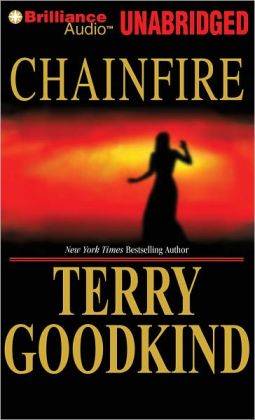
Book review: terry goodkind's chainfire

Friday 11 April 2014

Following on from my discussion of audiobooks in my last post, 'Reading habits in the modern age', and considering the interest this review generated on Facebook when it cross-posted from Goodreads, I thought it was worth throwing up here as well. Stay tuned for more scathing reviews as I continue needlessly to torture myself with Goodkind's works until I'm all caught up ...


Deplorable Ayn Rand fanatic Terry Goodkind's sole plot device of separating hyperbolically perfect lovers Richard and Kahlan recurs yet again in Chainfire, if in a slightly more interesting incarnation this time, with the erasure of Kahlan from everybody's memories but Richard's. This results in some characteristically tedious, repetitive, unrealistic, interminable, eyeroll-inducing exchanges between Richard and other characters as he tries to convince them of his inevitable correctness against their insistence that he is deluded. Oh and also something about an invincible beast that (of course) horifically mutilates people to get to Richard. 

Goodkind has only my obsessive compulsion to finish what I start to thank for my continued consumption of his free market capitalist propaganda, and the fact that the books have been turned into audiobooks. I don't think I'd get through them if I had to will my eyes to continue relaying the derivative, uninspired words on the page to my brain instead of just tuning out and doing something else as the poor voice actor drones on and on, trying to intone the author's awkward phrases with any sense of realism. There are also, of course, the obligatory clumsy, transparent, desperate, deluded attempts from the author to trick the reader into endorsing morally untenable positions that glorify selfishness and pose helping others as the greatest kind of evil, as well as other philosophies that support a purely self-interested free market capitalist, minimal-government, nonexistent welfare dystopia. 

The book ends on a cliffhanger to propel you into the next book in the triology, and I have to admit despite my innumerable objections that I'm usually interested in what happens at the end of each book as events (finally) reach their climax. Anyway, I'm one book closer to catching up to Goodkind and hopefully not reading another book from him for many years to come (or ever again).

Thanks for reading

LPL

Saturday, 23 July 2011

Book review: tina fey's bossypants

Saturday 23 July 2011
(Updated Wednesday 4 January 2011)

After a semester studying abroad, I recently spent forty-six hours straight languishing in Heathrow Airport, a fact to which I'm sure any of my Facebook friends will attest, due to the incessant status-update plangencies that would have been plaguing their feeds. Awaiting the time of my appointed, triumphant (or, rather, bedraggled and slightly malodorous) return to Sydney for such an expanse of time demanded considerable intellectual sustenance, but with internet access costing ten pence per minute and my AustralianUK adapter for prolonged use of phone, laptop or iPod out of commission, I was obliged to purchase more books from the limited selection of an airport-sized WHSmith.

Evidently my subconscious thought I was in need of cheering up because the two books I selected were Terry Pratchett's 679th Discworld installment, I Shall Wear Midnight, and Tina Fey's autobiography Bossypants. I think it must've been how hot she looks on the cover that made me choose to read Fey's book first:

Yowza! (A quote from Don Fey, Tina Fey's father, on the back cover under the heading 'advance praise for Bossypants' reads 'I hope that's not really the cover. That's really going to hurt sales.'

There's a certain puerile pleasure that comes with finishing a book in a single day, a psychological relic, perhaps, of a time when the measure of your coolness was how quickly you'd read the latest Harry Potter. In the case of Bossypants, however, I can't help but feel that it wasn't my reading prowess that accomplished the feat (especially since I'm not actually that fast a reader at all), but a certain ... 'thinness' in the book itself. At 277 pages, it felt a bit slapped together and brief, especially towards the end when Fey begins recounting individual scenes from 30 Rock and reproduces the entire transcript from her notorious Sarah Palin and Hillary Clinton Saturday Night Live skit, not that I didn't enjoy reading both of those. 'I could go on,' says Fey at one point, after having listed three or four lines-worth of luminaries to have emerged from an improv company she belonged to, 'but my editor told me that was a cheap way to flesh out the book' (81).

Reading it, though, you understand why Bossypants isn't a seven-tortuous-years-in-the-making magnum opus. You wonder, in fact, how she managed it at all, in spite of her insistence that the stress levels of her writing job are comically minimal (on a graph comparing them with those of miners, Chilean miners, and active military servicemen) and her hatred of being asked 'how she juggles it all'. I'm not sure about dismissing the difficulties of her working life by comparing them with the stress experienced by soldiers – it's not all about stress; it's about how much time you have in the day, which seems very little in Fey's case. The airiness of the book isn't necessarily a bad thing, anyway. It just makes it one of those 'light reads' you're always hearing about.

Besides, I don't think Fey has to try that hard to be funny. It felt effortless. Reading the book, I found myself lying on the floor of the Heathrow Airport Terminal 3 seating area pissing myself every couple of minutes, much to the annoyance of everyone trying to sleep around me, I'm sure. The funniest parts for me were those where she created an irregular mental image, such as in one of her tips for 'me time' activities when you have a baby: 'Say you're going to look for the diaper crème, then go into your child's room and just stand there ...' (243) or when she recounts receiving a Modess 'my first period' kit from her mother: 'I shoved the box in my closet, where it haunted me daily ... Everytime I reached into my closet to grab a Sunday school dress or my colonial-lady Halloween costume that I sometimes relaxed in after school—"Modesssss," it hissed at me. '"Modesssss is coming for you" (13–14). Or else it was the times she just slipped a joke in there with you barely realising until it hit you: 'Of course I know now that no one can "steal" boyfriends against their will, not even Angelina Jolie itself', or 'I'll bet Margaret Thatcher would say the same if she were alive today.* [And then, in a footnote] *Apparently Margaret Thatcher is alive and says of course she would have told the nanny about the problem and she thinks I am a complete chickenshit' (257).

It was lucky for all of this hilarity, because if you'd asked me if I wanted to read a book whose subject matter dealt predominantly with the female experience of puberty, beauty and appearance issues, feminism, motherhood, and photoshoots, you can guess what my answer would've been. YES PLEASE! But yeah, couldn't quite escape the fact that the book was marketed to women, which I didn't know when I bought it. 'It's not quite as quease-making as when you lose your tampon string,' she says of putting in contact lenses, 'but equally as queasish as a self–breast exam. If you are male, I would liken it to touching your own eyeball, and thank you for buying this book.'

But the book did irritate me every now and then. I got over the self-deprecating ugly jokes after a while. I mean, she's effing gorgeous, with a MILF rating off the charts, so what's she talking about!? I don't necessarily think it's fake humility, I just found it excessive. Maybe Australians have a more refined sensibility to self-deprecating humour, since it's like, our thing.

And all that talk of the facial scar! She kept on going on about it and I was like, huh? What is she talking about? I've literally never noticed it. In fact, I still can't find it anywhere on her face. Maybe it's makeup, or airbrushing, or distraction by her general hotness, or the fact that I've apotheosised her to the extent that I can no longer detect any form of imperfection in her person, I don't know. Actually, you know what it probably is? My habit of not paying attention to/retaining information about things I don't care about. Maybe if I watched Mean Girls again, I'd see it and be like, 'Ohhhh yeahhhh!' Any excuse to watch Mean Girls again ...

'Ugh, my facial scar is huge.'

Also, I think her editor was a bit overzealous on the quotation marks, there. It could've just been that they were all double quotation marks, but they really stood out to me, often as not really being necessary. It kind of made it feel like an awkward email from your best friend's mum, who's enthusiastic about the internet but hasn't quite mastered the conventions of e-communication yet and says things like, 'I heard from "our little girl" that you guys all had fun at the races last weekend! :D Did you make any "big wins"???!!! :oP'

And I'll admit, I was also a little disappointed with the number of mentions of God. You let me down, Tina. But my God-mention tolerance level is significantly lower than the average person's. It's not like she was preachy, or anything. I just expected such an obviously liberal, talented, intelligent woman to be ... irreligious.

Those small and few (is there an antonym for 'multifarious'? There should be ...) reservations aside, Bossypants was a hilarious "light read", as they say!!! :o) !!!?!