10 February 2018*
If you’ve never heard of Welcome
to Night Vale, you could surmise a lot from the crowd outside
Melbourne’s Comedy Theatre last night. It
seemed the entirety of the fandom’s local contingent had descended on the
corner of Exhibition and Lonsdale in full devotee regalia—geeky,
affable youths in official merchandise, gothic corsets and steampunk goggles,
bafflingly obscure costume homages, and hair dyed in every hue.
But the
prevailing colour of the night, sported by almost every second attendee, was
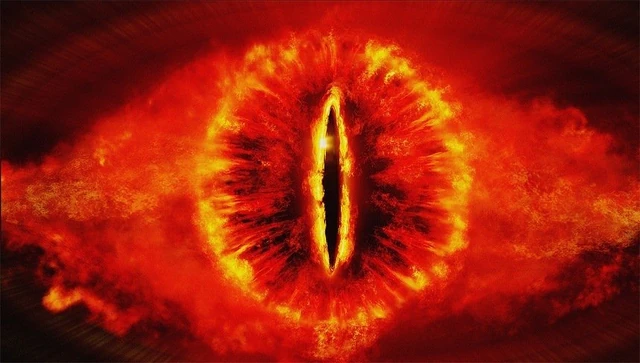
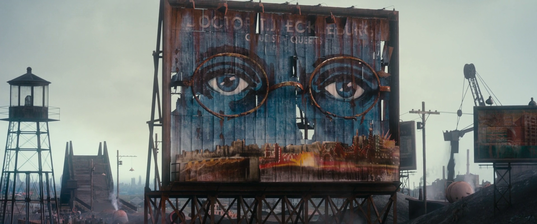
undoubtedly the signature purple of the long-running US podcast’s logo: a
runic, crescent moon–pupilled eye hovering ominously above familiar water tower
and powerline emblems of rural America, part-Sauron, part–Dr TJ Eckleburg.

Each episode of the bi-monthly internet series represents a
broadcast by fictitious radio host Cecil Palmer, beloved commentator on the
weird, nonsequitur, Lovecraftian happenings of Night Vale, an imagined desert
community populated by mysterious forces and agencies competing to terrorise
quiescent townsfolk. Fans of the show are drawn to its potent combination of
creepy paranormal tropes, deeply ironic and self-aware humour, and Tumblr-style
progressive politics promoting a message of universal acceptance for self and
other alike.
In the currently touring live show ‘All Hail,’ the sudden
inexplicable appearance above the radio station of ‘the Glow Cloud’—according
to the Night
Vale Wiki ‘an eternal deity predating reality and currently serving as the
president of the Night Vale School Board’—instigates abject worshipful
prostration and mindless recitations of fealty from the town’s populace,
sending Cecil on a mission to determine its motives and appease the malevolent
nebula.
The quest is punctuated by regular segments imported
from the podcast such as an infomercial from ‘sentient patch of haze’ Deb, a
collection of comically moribund horoscopes, a forecast of the delightfully bizarre
events scheduled on the Community Calendar and, of course ‘the Weather’—a performance
by the charming pint-sized musician Erin McKeown, who over-estimated the melodic
and mnemonic aptitude of the average Melburnian theatregoer with admirable consistency and
patience. The show also features appearances from new and recurring characters
in the Night Vale universe—snobby local music store proprietor Michelle
Nguyen, shapeshifting sixteen-year-old Josh Crayton, bibliophile teen militia
captain Tamika Flynn, and time-travelling intern Jeffrey Cranor.

Perennial motifs from the podcast find expression once again in ‘All
Hail,’ among them a recurrent anxiety about the rapid consumption and disposal
of culture and the pace of contemporary life. After entrapping the audience
into laughing at how ‘2014’ vaping is, the charismatic show-opener Meg Bashwiner
quips, ‘It’s just like a millennial podcast audience to throw shade at something
that was four years ago.’ And in the show proper, Nguyen references in
stereotypical upward inflection ‘super-old retro music like The Killers and
Usher.’ The obnoxious hipster persona Nguyen’s character satirises is itself a
little stale in 2018, though her appearance yields such highlights as the
fourth wall–breaking real-time, part-improvised narration of sounds from the audience and a
description of her so-called business plan as ‘a crude sketch of Noel Gallagher
being consumed by a golem made of cocaine.’
Likewise, the show seeks with some urgency to initiate the audience
into the experience of human connection so central to its ethics, reminding us
continually of the communality of viewership. ‘The sound of 950 people together
in a room sharing an experience’ is one of the sounds Nguyen identifies from
the audience, a sentiment echoed more pointedly in Cecil’s later ironic jibe,
‘Who wants to go out in public and share physical space with other people?’ Like
‘The Investigators,’ the last Night Vale live show to reach antipodean shores
in 2016, ‘All Hail’ exploits opportunities for audience participation to drive
this message home, enforcing hand-holding and protracted group recitations,
albeit with a little less success than its predecessor.
Loyal listeners will recognise in ‘All Hail’ the formula of several arc-ending
episodes of the podcast, which often conclude with emotive diegetic exhortations
from Cecil that have clear real-world political parallels. The show ends on an
impassioned plea to convert our good intentions into positive action if evil is
to be thwarted. ‘Books,’ Tamika Flynn says, are ‘potential human action,’ and
‘filled with empathy, which is much more heart-shattering than any bullet.’ And
‘good,’ we are told, ‘is an action, not a description.’
While timely, timeless and true (Bashwiner includes in her opening
address the embarrassed Trump apology fast becoming a standard convention for
every international American performance), this message is not so elegantly
grounded in the preceding performance as it is in past podcast episodes or in
‘Investigators,’ and feels superimposed rather than earned—a coda by deus ex
machina. Without spoiling the final act completely, plot events might have lent
themselves much more naturally to a conclusive sermon on the importance of
communication and making space for understanding one another than a tenuously
(or, dare I say, non-existantly) linked monologue on activism.
But the minds behind Night Vale know their audience and, judging by
the uproarious cheering, hyena-cackling, standing ovation and double encore this audience bestowed on the performers, it was not inclined to register the maladroit
delivery of a message it so firmly agreed with after an hour and a half of such
skillfully targeted entertainment. I’m not inclined to try to disabuse them,
but I would advise caution on behalf of those considering taking along friends
uninitiated in the Night Vale universe like I did, lest the audience’s Glow Cloud–like
adoration fail to take root in them.

*Note: I would've put this up this sooner, but I was delayed by talks with the editor of a website. It appears here with their permission.
Thanks for reading
LPL