Showing posts with label Terry Goodkind. Show all posts

Wednesday, 16 April 2014

Book review: terry goodkind's the omen machine

Wednesday 16 April 2014


The following review contains mild spoilers from the early parts of the book.

Having neatly tied up his myriad loose ends in the final instalment of the Chainfire trilogy, Confessor, Terry Goodkind embarks on a whole new mess in The Omen Machine, the first in another series of Richard and Kahlan novels. Seeking, it seems, to torture his characters almost as much as his readers by keeping the spaces between novels (and cataclysms) infinitesimal, a new existential threat emerges during the celebrations following the defeat of the previous one, launching us on what is sure to be yet another protracted, poorly (i.e. not at all?) edited, banal adventure full of impossibly, ridiculously evil villains for Kahlan to be kidnapped or poisoned or otherwise imperilled by and for Richard to lecture us about. 

As an editor, reading Goodkind’s writing makes me want to prostrate myself before his publishers and beg them to allow me even a few hours alone with his manuscripts and a red pen, pro bono, before he is allowed to pollute the language with them. There’s none of the occasional moments of descriptive beauty sprinkled throughout Goodkind’s earlier works to be found here, no hint of his rarely exhibited though nonetheless surprising appreciation for detail. The prose is unwieldy and halting, repeated words clanking harshly up against one another and giving the book an overall careless, rushed feel à la the latter works of Raymond E Feist. It’s as though some of these B-grade epic fantasy authors work out that most readers don’t care how well-written their books are and they can just crank out sequel after sequel and make the same amount of money.

So, of course, it’s impossible to catalogue all the problems with a Terry Goodkind book in a single review, so I’m going to restrain myself to just one: his notorious monumental ego. Or rather, one way it manifests in his works. Possessed of a great number of opinions, ranging from morally reprehensible to innocuous, on any number of topics, Goodkind’s motivation in writing seems to be to embed as many of them in his books as often as possible, largely through the simplistic device of using his exaggeratedly perfect (in the world of the books, anyway) protagonist Richard directly to spout them for him. Plotting for Goodkind seems more an exercise in engineering various situations in which Richard can argue with and lecture other characters and the reader on one of these opinions than any conventional dedication to the integrity of the story or the gratification of the reader. Indeed, each novel is largely propelled not by action, but by argument. Revealing of their didactic impulse, the narratives largely turn on episodes in which different characters discuss events and ideas and try to convince one another of different positions in laborious exchanges that persist much longer than believability would allow.

The result is that the reader finds themself mired in perpetual, incessant exchanges between characters on subjects both mundane and esoteric, extended disputes over how best to organise and catalogue a library alongside lengthy treatises introducing abstract magical concepts that are never grounded in any previously established logic. These latter logomachies always reveal new concepts all at once, so the reader is never granted the chance to anticipate or share in the reasoning. It’s just Richard presenting some new element of the nature of magic that hasn’t come up before in any of the previous twelve overlong tomes, that completely explains what’s going on in this book, while everyone else disagrees that it’s possible until he is inevitably proven correct.

Goodkind facilitates this recurrent magical Deus ex machina at first by way of the charade of Richard’s ludicrous decision not to ‘depend on his gift’, even though he supposedly epitomises rationality and it is completely irrational for him to refuse to learn about an inescapable part of himself that could be so helpful to him, and later by making Richard a ‘war wizard’ whose magic is mysterious and able only to be activated by need and emotion, very conveniently giving it scope to work in any way the author chooses in future, failing to lock him in to any constraints. Such constraints are the very things that ordinarily make suspension of disbelief about magic possible in other series, the things that allow the reader to find any plots involving magic satisfying – that we know the way it works, that it has limits.

And I wasn’t kidding about the library debate, either. Just under an hour into the audiobook, an illustrative example of one of these monotonous, one-sided duologues occurs when we find ourselves in the royal library of D’Hara, the capital city of the eponymous empire ruled by Richard. After pacing for some time, Richard’s absurdly named grandfather, First Wizard Zeddicus ‘Zedd’ Z’ul Zorander, halts and proclaims that he’s ‘not convinced that it can work, Richard—or at least, work effectively.’ What follows is no less than six minutes of discussion over whether or not the classification of all the books in the library is a worthwhile pursuit.

What's more, this doesn’t even seem to be a point of any importance in the novel. I guess they came across a book that turned out to be important, but there’s nothing to say they had to do so while undertaking a reorganisation of the library. We can probably safely assume that it will come back in some way in future (I’m halfway through the sequel The Third Kingdom at the time of writing), but is there anything that could justify such a prolonged, mind-numbing argument over library classification?

It can only be Goodkind’s zeal to prove the veracity of one of his opinions that leads him to prolong these exchanges so unnaturally beyond the realms of credibility. He needs the discussion to go on much longer than it should so he has room to get out all of his profound thoughts. Would Zedd really try so hard to dissuade his grandson from such a harmless endeavour as trying to catalogue all the books in his library? And even if he would, is it really necessary for the reader to be subjected to it? So often does Goodkind deploy this device, it’s beginning to feel like Zedd never believes Richard about anything, no matter how many times he is proven right. All the characters, in fact, begin to appear obsessive and stubborn, overly concerned with debating minor details, unwilling to see the (diegetic) truth of their opponents’ assertions, their likeability in the eyes of the reader sacrificed at the altar of Goodkind’s ego. The debates depend on an endless stream of meaningless ‘But Richard …’ interjections from the protagonist’s interlocutors to interrupt the pages of explanation and prevent the diatribe from collapsing under its own weight. The characters are forever asking one another ‘What are you talking about?’ and ‘What do you mean?’ and regarding one another as though they are crazy because of all the insane propositions and profound misunderstandings flying back and forth.

Another illuminating instance of this propensity comes in another early scene in the novel. Shortly after a woman confesses to infanticide in order to spare her children the more gruesome death portended by a vision, and then attempts to murder Kahlan to spare her a similar fate, reformed Sister of the Dark Nicci shows up on the scene seeming to already know of the happenings despite her absence when they occurred. It becomes immediately apparent to the reader that there must be more than one instance of this going on throughout the city, but the characters on the other hand are not so fast on the uptake, positively baffled by the things they are telling one another, and we are forced to wade through 750 words of tortuous dramatic irony as the feeble-minded cast tries to determine what’s going on. It’s like the Abbott and Costello ‘Who’s on First’ skit (or the Animaniacs ‘Who’s on Stage?’ skit for you '90s kids) but without the witty paronomasia! See for yourself:

“I didn’t see you at the reception,” Richard said. “Where did you hear about her killing her children?”

Nicci frowned up at him. “Hear about it? I was there.”

“There? What do you mean you were there?”

Nicci folded her arms and stared at him as if he were the one who was crazy. “I was there. I was down in the market helping to get people organized and hurrying them along to move into the passages in the plateau and out of what is shaping up to be a monstrous storm. They need to move into shelter. Those tents aren’t going to protect them.”

“That’s true enough.”

Nicci sighed as she shook her head. “So, I was down there in the market when the first one hit.”

The creases in Richard’s brow deepened. “What do you mean, when the first one hit? First what?”

“Richard, aren’t you listening? I was there when the first child hit the ground.”

Richard’s jaw dropped. “What?”

“It was a girl, not ten years old. She came down on a log wagon, on one of the upright stake poles. That pole was bigger than my leg. She came down face-first, shrieking all the way. It went right through her chest. People were screaming and running around in confusion and panic.”

Richard blinked, trying to makes sense of what he was hearing. “What girl are you talking about?”

Nicci looked at all the faces watching her. “The girl that the woman threw off the palace wall, over the edge of the plateau, after she had her vision.”

Richard turned to Benjamin. “I thought you said you found the children.”

“I did. We found both of them.”

“Both?” Nicci’s brow drew tight. “There were four of them. All four of her children hit within seconds of one another. The first, the girl, was the oldest. When the woman threw them off the top of the plateau they all landed right there near me. Like I said, I was there. It was a horrifying scene.”

Kahlan seized a fistful of Nicci’s dress at her shoulder. “She killed four more?”

Nicci didn’t try to remove Kahlan’s hand. “Four more? What are you talking about? She killed her four children.”

Kahlan pulled Nicci closer. “She had two children.”

“Kahlan, she had four.”

Kahlan’s hand slipped from Nicci’s dress. “Are you sure?”

Nicci shrugged. “Yes. She told me so herself when I questioned her. She even told me their names. If you don’t believe me you can ask her yourself. I have her locked up in a cell down in the dungeon.”

Zedd leaned in closer. “Locked up . . . ?”

“Wait a minute,” Richard said. “You’re telling me that this woman killed her four children by throwing them off the side of the plateau? And you locked her up?”

“Of course. Haven’t you been listening to anything I’ve said?” Nicci frowned around at everyone. “I thought you said that you knew all about it. Her husband found out what had happened and was going to kill her. He was screaming for her blood. I was afraid that the guards who grabbed the woman were going to let him have her. I sympathize with his feelings, but I couldn’t allow it for now. I had her locked up, instead, because I thought you or Kahlan would want to question her.”

Richard was incredulous. “Why did she do it? What did she say?”

Nicci appraised them all as if they had collectively gone mad. “She said that she had a vision and couldn’t stand the thought of her children having to face the terror to come, so she killed them swiftly instead. You said that you knew about it.”

“We knew about the other one,” Richard said.

“Other one?” Nicci looked from face to face, finally settling on Richard. “What other one?”

“The one who cut her two children’s throats and then came to the reception and tried to kill Kahlan.”

Nicci’s concerned gaze darted to Kahlan. “Are you all right?”

“I’m fine. I took her with my power and had her confess. She told us what she had done and what she intended to do.”

Nicci pressed her fingers to her forehead. “Wait, you’re saying that there was a second woman who also had a vision and killed her children?”

Kahlan and Richard both nodded.

“That would help explain why people are so unnerved and want to know what prophecy has to say about it,” Richard said.

“What’s going on?” Nicci asked.

JESUS CHRIST. YES. THERE WERE TWO INSTANCES. I THOUGHT YOU WERE SUPPOSED TO BE THE GOD-DAMNED SEEKER OF TRUTH, ABLE TO MAKE GARGANTUAN LEAPS IN LOGIC IN A SINGLE BOUND. WHY DOES IT TAKE SEVEN HUNDRED WORDS FOR US TO ESTABLISH THIS? WHY GOD-DAMN YOU WHY? STOP THE MADNESS. WHY AM I READING THIS GARBAGE?

Thanks for reading

LPL

Friday, 11 April 2014

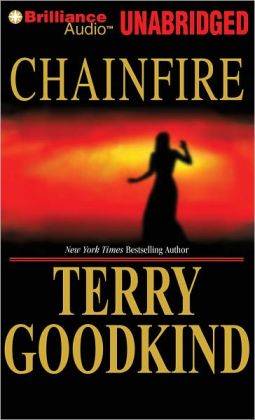
Book review: terry goodkind's chainfire

Friday 11 April 2014

Following on from my discussion of audiobooks in my last post, 'Reading habits in the modern age', and considering the interest this review generated on Facebook when it cross-posted from Goodreads, I thought it was worth throwing up here as well. Stay tuned for more scathing reviews as I continue needlessly to torture myself with Goodkind's works until I'm all caught up ...


Deplorable Ayn Rand fanatic Terry Goodkind's sole plot device of separating hyperbolically perfect lovers Richard and Kahlan recurs yet again in Chainfire, if in a slightly more interesting incarnation this time, with the erasure of Kahlan from everybody's memories but Richard's. This results in some characteristically tedious, repetitive, unrealistic, interminable, eyeroll-inducing exchanges between Richard and other characters as he tries to convince them of his inevitable correctness against their insistence that he is deluded. Oh and also something about an invincible beast that (of course) horifically mutilates people to get to Richard. 

Goodkind has only my obsessive compulsion to finish what I start to thank for my continued consumption of his free market capitalist propaganda, and the fact that the books have been turned into audiobooks. I don't think I'd get through them if I had to will my eyes to continue relaying the derivative, uninspired words on the page to my brain instead of just tuning out and doing something else as the poor voice actor drones on and on, trying to intone the author's awkward phrases with any sense of realism. There are also, of course, the obligatory clumsy, transparent, desperate, deluded attempts from the author to trick the reader into endorsing morally untenable positions that glorify selfishness and pose helping others as the greatest kind of evil, as well as other philosophies that support a purely self-interested free market capitalist, minimal-government, nonexistent welfare dystopia. 

The book ends on a cliffhanger to propel you into the next book in the triology, and I have to admit despite my innumerable objections that I'm usually interested in what happens at the end of each book as events (finally) reach their climax. Anyway, I'm one book closer to catching up to Goodkind and hopefully not reading another book from him for many years to come (or ever again).

Thanks for reading

LPL

Tuesday, 1 April 2014

Reading habits in the modern age

Tuesday 1 April 2014

I'm a big fan of lists. I have a list to keep track of what I'm doing and what I'm supposed to achieve every day of the week, partly because of OCD and partly because I'm too hopeless to remember everything I have to do (sometimes I even list the individual steps of 'hanging out the washing' and 'bringing in the washing' just to feel the sense of accomplishment when I cross them off). So for a few years now I've kept a list of books to read, and more or less pondered through it chronologically. This, I take it, is not abnormal. Most readers seem to resort to lists to realise their reading aspirations. Got a recommendation? Put it on the list. A friend or lecturer writes a novel? Put it on the list. An interesting-looking book wins a prestigious award? Put it on the list. An extreme but admirable instance of this practice would be the Rory Gilmore Reading Challenge, which illustrious word-man Patrick Lenton is currently undertaking over at Going Down Swinging.

Reading ... TO THE EXTREME.

Despite my appreciation of this simple form of time management and goal achievement, however, I've recently had to abandon my list in favour of a spreadsheet.

I know, right? What a sign of the times. What a statement for the digital age. What a symptom of actual obsessive-compulsive disorder. But yes, I'm afraid it is so. In the fast-paced, time-poor world of a tech-savvy Gen Y bibliophile, a list simply will not suffice. There is so much to read, and every year stacks a heap more onto the pile. In the words of the 'grim narrator' in Markus Zusak's The Book Thief, 'There are many things to think of. There is much story' (2008, page 263).

The Book Thief predates doge, I believe, so that turned out to be an unfortunate choice of phrase.

On top of the library's worth of literature to read, there's the smorgasbord of platforms on which to read it: the traditional printed book, audiobooks, ebooks, podcasts, even tweets or, if you piss off the right person, text messages. And what are you supposed to do when someone decides to make a movie of a book on your list? You want to read it before it comes out, so you have to skip ahead. And don't your friends who get published deserve your immediate attention? What about when a friend loans you a book and you want to get it back to them? Or worse, when someone buys you a book and expects you to have read it by the next time you see them? And how do I make sure I'm getting the right nutritional balance of genre and literary fiction, classics and contemporary, fiction and non-fiction? Throw a few literary journal subscriptions and university readings in there and your literary lifestyle is a nightmare. The linear chronological hierarchy of the humble list simply cannot keep up with the postmodern pastiche, the multifarious mayhem of intersections between platform and genre and kind and motivation that is modern reading.

Lacking some kind of futuristic Deleuze and Guattarian reading rhizome, however (I'm not that tech savvy), the best I can do is a spreadsheet which, in its current, incipient form, looks like this:

Blue is reading, green is read.

In case you can't see at that scale, it's currently divided into ten different columns: 'classics', 'contemporary', 'literary journals', 'non-fiction', 'recommendations', 'friends' (someone I know with a book), 'movie adaptations', 'audiobooks', 'masters' (books I'm reading for research), and 'favourites' (works whose authors I like so much I want to read their entire oeuvre). This kind of compartmentalisation captures all those types of books and the motivations for reading them I outlined above and systematises them, something I find way more satisfying than I should for some reason. So far (nascent though it is) it has proven a more democratic way to read, varying my literary diet in a very enjoyable way.

But as if all this wasn't enough, the spreadsheet comes with some attendant 'rules' I automatically seem to follow. I started this 'list 2.0' reading a recommendation from my nan, Stella Gibbons' Cold Comfort Farm, so that's where I started on the chart, moving laterally across the columns from there through my old lecturer Christine Howe's first novel Song in the Dark, the launch for which I attended a shamefully long time ago and which I have only just read now thanks to this new system, and onto Tim Winton's short story cycle The Turning, which I wanted to read before I saw the new film adaptation(s), before coming to John Fowles' The French Lieutenant's Woman, a seminal metafictional text my supervisor advised I read for my masters. And around here is where it gets complicated, with audiobooks, classics and literary journals (favourites is a new column).

As part of my 'traipse through canon', I want to read a great swathe of classic literature right from the beginning (hence The Epic of Gilgamesh). But I don't just want to read it: I want to read it critically, take notes, write down quotes, and do parallel research so I can write about it. All this takes time and space and energy that I don't always have when I've just got a few minutes to do some reading (as the interminably slow crawl of my progress bar on Goodreads currently attests). Furthermore, when I set out to tick a canonical book off my list, I usually buy a nice hardcover addition to add it to my collection, and these can be unwieldy to carry around. So I've decided to have a hardcover classic on my bedside table at all times, reading it whenever I get the chance to read at home.

More portable literary journals, conversely, I take out with me when I know I've got to wait in a doctor's surgery or at the bus stop, or for when I'm on the train. I like to think of this as doing my part to increase the visibility both of reading as an activity and of the journals as viable leisure-reading publications for those who cannot abide the inanity of Zoo or Cleo or Woman's Day or The Daily Telegraph, not that anyone's going to look at me in public and think, 'Woah, that guy's cool, I'm also going to read.' It's silly, because I'm often on my phone just like everyone else, but when I'm on the train and see everyone looking down at their iPads and iPhones instead of reading books I (somewhat irrationally) feel like literature is losing the war, which accounts for this little bit of perceived literary exhibitionist pageantry.

And finally, audiobooks. I love them. If you take nothing else from this otherwise largely pointless and meandering post, take this: buy audiobooks (and no, this post is not sponsored by Audible.com, although, if you're reading this Audible execs, maybe it should be). They're a fantastic way to turn mindless tasks and unproductive spans of your day such as walking to the shop or driving to work or doing the dishes into time well-spent (although, of course, a certain amount of mind-wandering time is essential for reflection and spontaneous thought). Podcasts are good for this too, notably the New Yorker Fiction Podcast. They're also fast, to some extent because of this capacity to be listened to any time, anywhere. They don't require dedicated time to sit and read. They don't busy your hands and eyes, just your ears and mind. It's for this reason, looking at my chart (and, for that manner, my reading catalogue), that I appear to get through them about four times faster than physical books.

In some ways, this aspect of the audiobook is all that gets me through my job. I'm an editor who works on billion-dollar submissions for tender. That's when the state government is like, 'We want a hospital designed and built and run and cleaned and maintained for thirty years', and a bunch of companies are like, 'We'll do that for teh monies!' and then the state is like, 'Well, tell us how you're going to do all this stuff better than your competitors by responding to hundreds of pages of questions and specifications'. These companies hire the company I work for to read the thousands of pages they generate in response to these questions and critique, edit, proofread and, in some cases, rewrite them, making sure they answer the question and flow nicely and such. Which is hard because this stuff is mostly written by non-writerly engineers and financial people and architects and lawyers and other people who don't do words that well (okay, it's mostly the engineers who are trouble). Given that it's usually just me and my boss working on all this for about six weeks and getting paid quite well, we are under a lot of pressure, which means ten to fourteen to eighteen-hour days and all-nighters as the deadline approaches, which means very little personal time, which means those precious spare moments I do have are extremely valuable. During these weeks, all that keeps me sane is living another life in the gaps between periods of work through audiobooks. Waking up, eating breakfast, catching a taxi, walking to the office, taking my lunch break, brief trips to the bathroom, showering, ironing my clothes: these become the only moments I have to myself, and it's wondrous being able to fill them with literature instead of only the banal mechanics of eating and washing and moving between spaces.

My good friend and fellow aspiring author Gilly put me onto audiobooks a couple of years ago when she advised that they were a good way to get on top of all the readings we had to do for our Theory for Practising Writers classes. I'll never forget the experience of my first audiobook, Charlotte Brontë's Jane Eyre, and how much more emotive it was when read passionately aloud, or Jeremy Irons reading Vladimir Nabokov's masterpiece Lolita (and then having weird incongruous flashbacks when we visited Westminster Abbey and he narrated the audiotour).

'Jeremy's ... iron?'

Audiobooks can even facilitate the reading of bad books, so you can tune out for a while as the voice actor makes the effort for you. Perhaps if I'd read the works of Terry Goodkind and Robert Jordan in physical form instead of as audiobooks, I would finally understand those people who purport to 'throw books across the room' when I came across the more politically questionable and gender essentialist passages therein.

But the speed of audiobooks does make them a good way to get through a lot of your reading list  (or matrix, as the case may be) quickly. I started out using them for university readings as Gilly suggested, then commenced my 'traipse through canon' with them, downloading audiobook versions of the public domain classics for free through Librivox (although there is obviously a compromise in quality with these). But I actually found I was racing rather than traipsing through canon in such a way that I was forgetting what I'd read and, of course, I couldn't take down notes and quotes as easily.

This is the one drawback of audiobooks for me (apart from the fact that the audial equivalent of losing your page is much more frustrating!). You lose the ability to go at your own pace, unless you want to distort the sound laughably by using your device's 'slow down' or 'speed up' functions, and even then. With literary fiction, I love to take my time and luxuriate in the language, going back to read over certain passages a few times, relishing the look of the words on the page. That's why I've largely started listening only to pure entertainment-value books as audiobooks, mostly (very bad) fantasy like Feist, Jordan, Collins and Goodkind and some not-bad fantasy like Martin and Pullman.

So you can see how a matrix becomes necessary to track all of these literary endeavours. I'm reading hardcover classics in bed at night, laptop by my side to take notes; I'm reading literary journals on the train and in waiting rooms, flaunting the covers for all to see; I'm filling the banal gaps in my existence of shopping and putting the washing on (and hanging it out and bringing it in and folding it) with terribly written fantasy adventures, all the while proceeding through a rotation of award-winning contemporary fiction, non-fiction of interest, recommendations from friends, books for research, books by friends and books with impending film adaptations. I'm just not the type of person to spontaneously pick up the next thing that takes my interest. For whatever reason I have to feel like I'm reading it all, covering all bases, playing all angles. Let's just hope this level of obsession never escalates. If I ever start talking about book algorithms and reading dice-rolls, you have my permission to commit me.

Thanks for reading,

LPL
Facebook | Twitter

References

Markus Zusak's 2008 novel The Book Thief, published by Picador.