Showing posts with label Environmentalism. Show all posts

Wednesday, 28 February 2018

Firebrands and double-edged flaming (s)words: the wheeler centre gala 2018 review

Wednesday 28 February 2018


Monday’s eighth annual Wheeler Centre Gala saw eleven intellectual incendiaries light up Melbourne’s Athenaeum theatre with variations on the likely theme—for an institution dedicated to the holy trinity of books, writing and ideas—of ‘words on fire.’ The characteristically malleable topic incited diverse interpretations from an estimable ensemble of writers, performers and activists, ranging from personal parables to political polemic, performance and poetry.

And diversity truly was the word of the night. Excepting the transitory appearance of Centre director Michael Williams, who seized the stage long enough only to make his obligatory thanks, gracious self-deprecation and inevitable lefty in-jokes about African gangs and the definition of ‘partner,’ the lineup was a veritable straight white male–free zone. Indeed, holding forth as the speakers did on such progressive subjects du jour as environmentalism, disability rights, Indigenous oppression, the trans experience, class politics and even a content warning or two, the roster could well have emerged wholesale from the very nightmares of Miranda Devine.

Any outnumbered conservatives in the crowd might have snatched hungrily at Aunty Carolyn Briggs’ portents of overzealous offence-taking and language-policing as a slippery slope toward censorship, but the Boon Wurrung Elder’s discussion of privilege and disadvantage in language use revealed a position far removed from the typical PC-bashing proponents of Brandis’ ‘right to be bigots.’

Briggs’ extended Welcome to Country offered a sedate start to the evening, with reflections on the history of words as weapons used both by and against Indigenous Australians, pointing to the subversive meanings said to hide in Aboriginal names such as Coonabarabran (putatively ‘white man’s shit’) and the Moomba festival (folk-etymologised not as ‘let’s get together and have fun’ but rather ‘up your bum’). 

Briggs concluded by inviting the audience to use the language of the land—wominjika for ‘welcome’—and to fulfill the obligations traditionally attendant on that welcome: ‘not to harm the lands and waters and not to harm the children.’ It was an exhortation later taken up by Indigenous author Tony Birch in his address, an admiring paean to Wangan and Jagalingou spokesperson Murrawah Johnson and her incendiary words to author–activist Naomi Klein on Adani’s proposed Carmichael coal mine: ‘We have seen the end of the world and we refuse to accept it.’ Birch traced the violence enacted upon Johnson’s ‘personal and genealogical history’ through the language of Terra Nullius and the Acts of Parliament that have governed Indigenous lives to illustrate the heroism, the injustice, and the irony of her leadership in the fight against the mine.

My view of the stage through the perfectly curled wave of another spectator’s hair.

Before thirteen asymmetrical bars of light flaring and fading between performances like the still-glowing trunks of bushfire-blackened trees, each speaker took to the stage in succession, without the intrusive inelegance of any master of ceremonies offering aggrandising introductions. This lent the night the dreamlike intimacy of yarns around a transfixing campfire, each one free to roll into the next and build upon it without any break in the spell.

Commencing the official program was writer, actor and director Leah Purcell’s lively autobiographical narrative, a touching and comic recount of the words and phrases that marked her lifetime journey from poor rural daughter and young caretaker of an alcoholic single mother to the acting career she had always dreamed of. Replete with a reenactment of the dance she performed impromptu down the main street of Bergen after a compliment from a stranger, the tale at moments challenged even Purcell’s polished performance skills with tears. Malaysian-Australian poet and rapper Omar Musa likewise gave a stirring personal account of his lived experience, counterbalancing the poetic drama of the oration to come with a casual ‘’S’goin’ on?’ as he arrived onstage. He spoke of his lifelong battles with a father fervently devoted to the Word of God, and the secret words of inspiration imparted by his mother in stolen eight-minute car rides on the way to school. And in the night’s penultimate speech, blogger and activist Carly Findlay drew on her (ever-political) personal experiences to question whether social justice movements actually live up to the buzzwords of inclusivity, diversity and intersectionality when it comes to disability.

A persistent motif, of course, was the power of words. The power of a politician’s well-crafted speech to inspire a lifetime of loyalty in the case of writer and anthropologist Sally Warhaft’s Republican niece, or Warhaft’s own affection for the rhetoric of Paul Keating, which preceded a writer’s lament for the declining communicative power of today’s politicians at home and abroad. Or the power of writing to give a child control and escape from an unstable upbringing that a garlanded and needlessly bashful Rosie Waterland—she of the famed Bachelor recaps—conveyed. Veteran of the Melbourne Workers Theatre Patricia Cornelius too demonstrated the potency of words forcefully in the opening of her crowd-pleasing ode to profanity, with a rapidfire fuck-and-cunt-laden tract from her play SHIT (a linguistic challenge to which the Auslan interpreter rose admirably). In the comedic highlight of the evening, Cornelius delivered an insightful interrogation of the class politics of snobbery about swearing, railing against the bourgeois insistence that the theatre remain a polite, expletive-free middle-class space and the notion that the underclasses should never express legitimate rage through swearing. 

Other presenters built on Briggs’ earlier meditation on the nature of words as double-edged (flaming) swords – their ability, in Williams’ terms, to burn and to heal. From honey, darling and sweetheart to dude, bro, mate and man, queer nonbinary activist and writer Nevo Zisin reflected on the usefulness and limitations of words and labels in defining and limiting their identity pre- and post-transition, while actor Rachael Maza powerfully contrasted narratives of her grandfather from biased official records against family memory and empathetic deduction, lingering over the difference between the concept of history and the past itself.

The crescendo of the pyrotechnic spell which the speakers had been steadily constructing over the course of the night came in the final empyreal performance by Moira Finucane, who fully earned her description as a ‘writer, director, performer and creator of volcanic and magic realist worlds … and intimate theatrical spectacles, internationally renowned for her arresting mix of provocation and entertainment.’ Bedecked in a shimmering black gown and headdress somewhere between the Statue of Liberty’s aureolic diadem and Westeros’ Iron Throne, she emerged onstage swaying and arm-waving in time to cosmic strains. ‘Kingdom Animalia,’ she intoned in the commanding resonant boom of an elven queen. ‘Phylum Chordata, just like us. Not like us, Class Aves,’ she continued as if reciting words of power. ‘Family Alcidae, Genus Pinguinnis, Species Impennis.’ This scientific classification of the now-extinct great auk launched an abstracted traipse through humanity’s relationship with the planet as viewed through writings both dramatic and innocuous, from Proverbs 26:11, to the cruel 1794 words of sailor Aaron Thomas on the ill-fated penguins, to Charles William Beebe on extinction in 1906, to Rachel Carson in 1962, to 2018 personal correspondence from another Indigenous environmental firebrand, Eleanor Dixon (‘a genius with 60,000 years of understanding of her land’) to Stan Grant in 2016 and Desmond Tutu in 1999.

Though her declamatory style courted the absurd and at times dipped into the ridiculous, Finucane performed with such ardor and conviction that a possibly skeptical audience stayed with her, tittering only, perhaps, as intended, when the monologue descended abruptly from the grand themes of environmental destruction to supplying the tangible details of how to contact the Northern Territory Chief Minister’s Office to express concern over the impact of fracking on the tourism industry, all while maintaining its grandiose delivery.

Paraphrasing Tutu as she slowly departed (perhaps significantly to stage left), she encouraged her viewers to keep ‘trending, trending, trending towards the good,’ and left the audience in the lingering strings and darkness to awaken with the lights as if from a dream.

If the gala is a sign of what we are to expect from the Wheeler Centre in 2018, it will be an impassioned, diverse, provocative, progressive year indeed.

Thanks for reading

LPL

Friday, 19 June 2015

Vegan options at summer hill hotel


Friday 19 June 2015 


I had a pretty funny experience at the Summer Hill Hotel last night, but it didn’t have anything to do with their ‘comedy’ trivia. My girlfriend and I went along with her brother and two of his colleagues, and finished up at a respectable third place. Afterward, when it had emptied out a bit, we got talking to one of the bar staff who was coming around to clean the tables. While he was hanging around, Tilly noticed a sign saying they do veggie burgers on Mondays, and asked him why only on Mondays. We’ve been to the pub a couple of times and they only have two vegetarian options, neither of which can be veganised, so the only vegan option is a bowl of chips (almost certainly fried in the same oil as the chicken schnitzel). Keep in mind that this is in Sydney’s inner west, possibly the most vegan-friendly place in Australia outside of Melbourne, where just down the road I could ask for no fish sauce or oyster sauce in my stirfry at the Thai place or no cheese on my pizza at the Italian and get the response, ‘Oh, you mean vegan?’ 

‘Good question,’ he answered. ‘I don’t know. I assume all the ingredients are there right now, but we only sell it on a Monday.’ 

There was a bit of a back and forth where he bitched about his evangelistic vegan ex-girlfriend and her hypocrisy in drinking non-vegan wine and wearing leather shoes, and then Til volunteered that I was vegan and he started interrogating me about wine and shoes and honey, absurdly insisting that bees have no use for it (!?!?). Then he said, ‘It’s funny, ’cause we actually got this loooong email a while back from some vegan who wanted more options on the menu. And for the first few paragraphs I was on board; I was like, yeah, mate, I agree, but then he got to the part where he started trying to preach and stuff and I was just like ‘Nup.’’ 

Then he talked a bit about how he ‘gets’ people who do it for the health reasons, and that he’d do it for the health reasons but he loves chicken, but he doesn’t get people who say it’s for ethical reasons. 

When he walked away, I turned to the rest of the group and said, ‘Yeah, so the guy who sent that email was me,’ and everybody lost their shit. No one could believe that had happened. I hadn’t said anything because I wanted to hear what he had to say honestly. It was like being able to eavesdrop but he was talking straight to my face – quite a rare opportunity, really. 

Not that it particularly helped. After the encounter I dug up the email and read it back to myself to try and see where he was coming from. Obviously his reaction is not the desired one for my cause. I know that people often respond negatively to any discussion of veganism, so that was nothing new, but in this case I thought I’d tried to be particularly non-threatening and polite because I was trying to effect a concrete change. But see for yourself! I’ll copy and paste the contents below, with a little commentary. 

Firstly, I guess the email was pretty long – four paragraphs in total, but I’m just a longwinded, thorough person and that probably won’t ever change. I didn’t want to just send a three-line email asking for vegan options, I wanted to make a case and give some suggestions, too. 

My first paragraph was basically just sucking up to them and setting up the situation: 

     To the management of the Summer Hill Hotel/AHL Group 


     My girlfriend and I have just moved into the area, and we'd heard great things about 
     your establishment, so we decided to try out the hotel for our first lunch after a big 
     morning moving in. We loved the atmosphere and service at the hotel, but were a bit 
     disappointed that there were no vegan meal options available at your bistro, and the 
     two vegetarian options were unable to be 'veganised' because they were pre-prepared 
     and contained fish sauce and dairy products respectively. 

Nothing to see here, right? Pretty tame? 

Next I got to the point of the email: 

     We're eager to make your establishment our new 'local' for drinks, trivia, and lunches
     and dinners with friends, but obviously we'll have a hard time if there's nothing we 
     can eat there! So I'm just emailing to ask if there's anything you can do to 
     accommodate vegans in your meal options – whether it's enabling one of the 
     vegetarian options to be altered for vegans, or even adding a new menu item. 

Again, pretty reasonable, I think. 

My third paragraph was about establishing common ground in case they were thinking ‘Jesus, no meat, dairy or eggs – what the hell does he want, then?’ (a common reaction). I explained what veganism actually is, which, in retrospect could’ve sounded a bit patronising, but you’d be surprised how many people don’t actually know, so I had to explain it to be sure. Here I also gave some suggestions for actual meals, because it’s generally good practice not to just point out a problem, but  also to arrive with a solution, and I think a lot of classically trained chefs and cooks have just never contemplated cooking something without meat, dairy or eggs, so I wanted to show that there were viable options:

     I come from a family of chefs, so I know veganism can sound prohibitively 
     restrictive at first. We essentially don't eat (or use) any products that involve 
     harming animals, so no meat, dairy, eggs, honey, etc. But there are actually so many 
     inclusive, delicious vegan meals that anyone can enjoy, even staunch meat 
     enthusiasts (if they give it a try)! At other pubs in the past I've had wonderful veggie 
     burgers; simple mushroom, tomato and herb pastas; open pies of roast veggies in 
     (dairy/egg-free) filo or shortcrust pastry; falafel and hummus pitas with salad; nachos 
     with beans; and vegan pizzas. Often other pubs go to the extra length of making their 
     vegan meal gluten-free as well, so they always have at least one option that anyone 
     can enjoy, whether they're vegan, vegetarian, pescetarian, lactose-intolerant, 
     gluten-free or whatever else! 


'Anyway, I was just reading your final edit, and um, there seems to be an inordinate number of exclamation points ... 'It was a damp and chilly afternoon, so I decided to put on my sweatshirt!' ... 'I pulled the lever on the machine but the Clark Bar didn't come out!''

But still, maybe just annoyingly nice, right? Not exactly raging preachy vegan yet? 

But these were all still the paragraphs that he’d been ‘on board’ with. It was the last one he said he had an issue with. And I can definitely see why. The last paragraph was where I raised the issue of ethics. It wasn’t in my original draft of the email, but then I found this pamphlet on their website that was basically fifteen pages of them bragging in poorly written copy about their commitment to ethical food sourcing and sustainable environmental practices and I thought, ‘Well, then I’ll bring up how maybe offering a SINGLE vegan option on your menu might fit in with your dedicated passion for ethical food and environmental sustainability’: 

     I was interested to read the ALH 'Our Sustainable Kitchen' brochure available on 
     your website and glad that all your meat seems to be procured as ethically as 
     possible. 

Okay, not really, but a bit of flattery couldn’t hurt … 

     As a company 'committed to ethical food sourcing and supporting environmental 
     resource management now and in the future', I hope you guys will look into 
     accommodating what I and many other people are increasingly finding to be the 
     most healthful, ethical and environmentally sustainable lifestyle choice available. As 
     you may know, growing crops to feed livestock around the world is the biggest cause 
     of habitat loss and deforestation, and raising animals for consumption contributes 
     more to greenhouse gas emissions than all our transport needs combined. 

     Thanks for your time and hope to hear back from you soon. 


     Cheers 

     Mr L Phillip Lucas, BA, BCA 
     Freelance writer and editor 
     

So, what? Is it that ONE sentence he took issue with, then? Merely making a claim about habitat loss, deforestation and greenhouse gas emissions? Claims the UN itself has validated by urging the world to move towards a vegan diet? To me it seems that people are just so sensitive on this subject that you literally can't say anything without being written off as ramming your ideology down people's throats. I think this ties back to a realisation I had the other day that I posted on my L Phillip Lucas Facebook page: 

     Shouldn't the real indicator of self-righteousness be the belief that all of our actions 
     are beyond reproach, that no one has the right to criticise our behaviour? As a 
     society, our fixation on 'judgement' is reaching phobic levels. In a world where most 
     of us never really think critically about our lives, it becomes easier to dismiss any 
     form of criticism as rude, judgemental, self-righteous, sanctimonious, holier-than
     -thou or preachy than to make sure our ideas and actions can stand up to criticism. 

They never did write back to my email. Apparently they just passed it around to all the staff, had a laugh at my expense, and now they bitch about it (to other vegan patrons???). I'm not really sure what I should've done differently, except not mention the ethical side of things. Obviously, in a way, I did get ‘preachy’ at the end there, but only to hold them to their own professed commitments. I wouldn’t have brought it up if they hadn’t done so first, bragging about their obviously bullshit passion for sustainability. 

Maybe you can write a more successful one than me. If you’d like to send them an email asking about adding a vegan option to the menu, that’d be amazing. If they hear it from enough different people, they might actually consider it. Their email is: SummerHill.Hotel@alhgroup.com.au 


Thanks for reading 

LPL

Tuesday, 22 April 2014

Little garie and the hidden shack communities of sydney's royal national park

Tuesday 22 April 2014

For someone whose entire life can be characterised by migration back and forth between Wollongong and the Sutherland Shire, the obstacle that separates these two places, Sydney's vast Royal National Park, is a constant presence. In my nearly twenty-five years I've made the move on no less than five occasions, each time leaving behind friends and family who needed visiting, so I must've taken the hour-long journey around and through the park, by car or by train, thousands of times.

In the original sense of the word, then, the park has been geographically pivotal for me: the central point around which my whole life has swung. So in the spirit of 'writing what you know', this 16,000-hectare conservation area seemed the perfect space in which to hide the hermit protagonist of my inchoate novel 'The Innocuous Death of Irving Crabbe'. It wasn't until I was voicing this idea to my nan, though, that I was informed of the extraordinary fact that the world's second-oldest national park already secretes within its depths a handful of isolated shack communities.

But apparently I wasn't alone. Surprisingly few locals, whether Shirefolk or Wollongongers, seem to be aware of the four micro-communities of Little Garie, Era, Burning Palms and Bulgo, each accessible only by walking track, which have been established in the park now for over a century. It only took a little investigation to reach the conclusion that I needed to incorporate these idiosyncratic little colonies into my book in some way. I was sold.

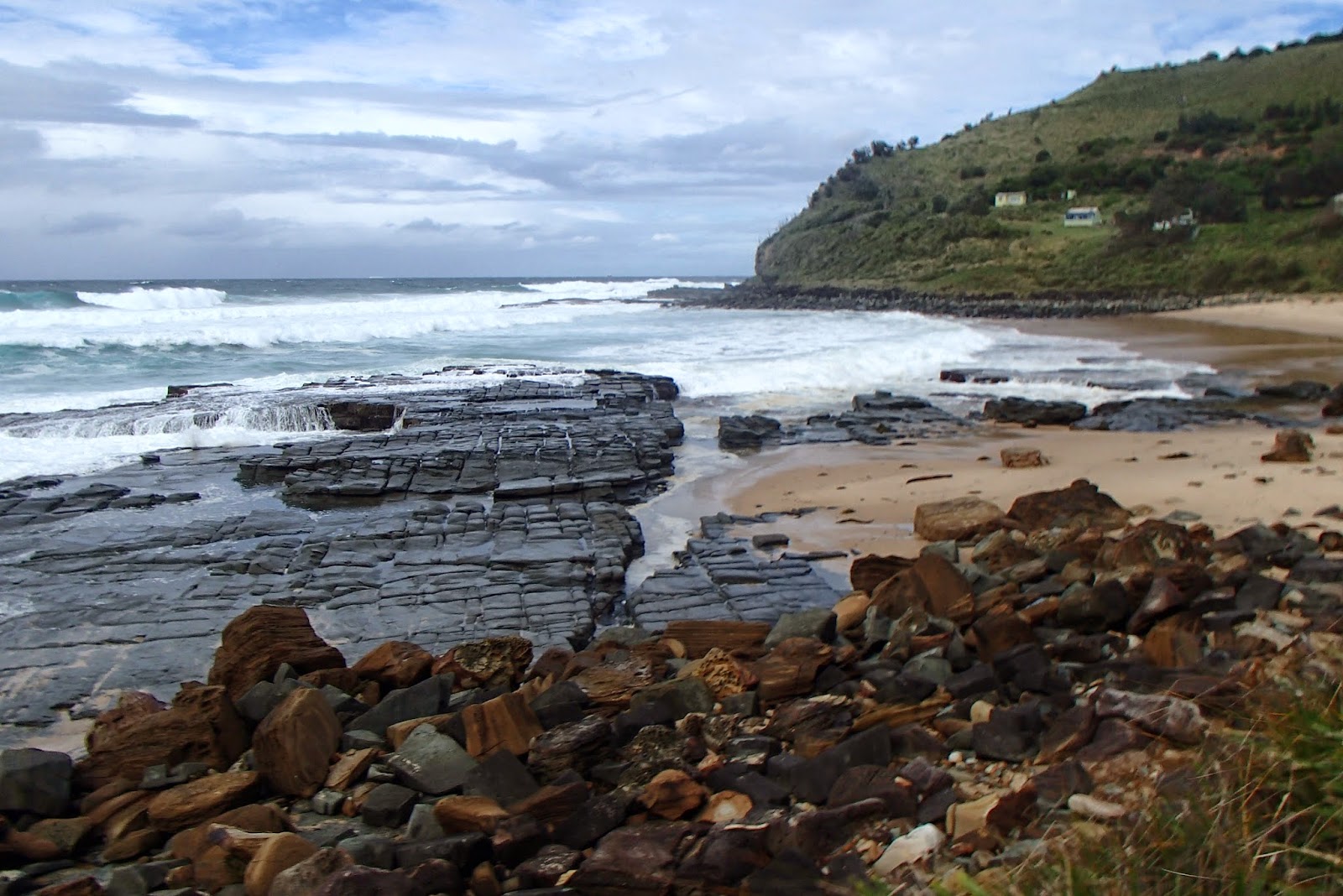
And so it is that at 10am on an inclement Sunday, just over a year after that initial discovery, I find myself on the wind-blown grass of Garie Beach in the heart of the National Park, accompanied by a fittingly representative mix of friends and family from both its Sydney and Wollongong ends. My nan brings three other family members from the south, while high school friends and fellow Sydneysiders Charlene and Alexandra (who accompanied me on my first excursion to the communities a year earlier) drive in with me from the north. They have all kindly agreed to join me for the annual National Heritage Trust Festival walking tour of Little Garie (the most accessible of the four communities and therefore the only tour not to have been cancelled due to the weather), where I'm hoping to learn more about the lives and history of the shackdwellers.

The glorious view from Garie Beach on our previous (much more temperate) visit.

We huddle against the wind and I make my introductions as my filial and social worlds collide, milling about a picnic table while we wait for all the attendees to arrive. We are surprised by how many people show up, perhaps a couple dozen: active middle-aged couples in hiking gear, a young migrant family with an adorable baby, and the various other pleasant, solitary grey-haired oddballs you find at such events, enthusing politely and asking earnest questions like garrulous mature-age students at uni. My friends and I are conspicuously the youngest adults there, later earning us the moniker of 'the young ones' from the event coordinator Kerry, who soon makes herself known and leads us on a narrow path towards Little Garie nestled between the cliffs on one side and the beach on the other.

Family: Nan, Eddie, and great aunt and uncle Christine and Stewart bringing up the rear. The 'most accessible' though it is, all the materials that comprise and fill the shacks of Little Garie would have to have been carried along this narrow path, including the heavy old kerosene fridges and cast-iron fireplaces.

The view from the track, with the rocky plateau where the shackholders meet for elevensies in the foreground and some of the Little Garie shacks beyond.

Warm and quick to laugh, Kerry strikes me over the course of the day as the most socially conscious of the guides, trying visibly to keep speeches from her fellow guides on track, forewarning us of the more notoriously loquacious shackholders and hurrying along any groups that linger too long in any one dwelling. She guides us up a steep hill, which she assures us is the only one we will need to contend with, to the characterful Little Garie community hall and chapel, where we are to meet the rest of the guides and residents: Tim, Peter, James, Gary, Tony and more. I didn't take any photos on this occasion, but I did take some during the 2013 visit:


Kids playing with a kart outside the hall.

In the hall we learn that the first shacks in the area were holiday cabins built from 1910 onwards on land rented from the owners, forty years before its incorporation into the National Park. Later during the Depression, the communities swelled as unemployed miners from nearby Helensburgh moved into the area. Once the land was resumed in 1950 after lobbying from the shackowners to protect it from property developers, no new shacks were permitted to be built. The existing shacks could, however, still be bought and sold until the mid-1960s when the land came under the governance of the newly formed National Parks and Wildlife Service (NPWS), whose policy was to remove the shacks once their owners died. This led many families to just continue paying rent under the pretense that their deceased relative was now a decagenarian. Nevertheless, the NPWS succeeded in demolishing around 50 shacks during this time. Apparently the removal of the shacks ranked in the top two things former NSW premier Bob Carr wanted to get rid of during his time in office, during the same time heritage authorities were clamouring to protect them.

Today the shackholders are council workers, medicos, PhDs, engineers, sugarcane farmers, coal miners and all manner of other professions. Indeed, one of the most distinctive shacks we would see, brimming full of fantasy novels and half built of stones that leak when it rains, is cared for by a kindly Woolooware High School science teacher/archaeologist/Egyptologist. Each shackholder pays circa $3,000 a year in rent, and they are entitled to have up to four names on their leases. Very few of them live in the shacks fulltime, but they visit frequently on weekends and stay for long periods over summer and during winter holidays. The custodians of such a prized coastal idyll might be expected to guard their closed community jealously against outsiders, but the open day shows their attitudes to be the opposite. In fact, it is due to their efforts to the contrary, largely exercised through the Royal National Park Coastal Cabins Protection League (RNPCCPL), that the NPWS' policy of shack removal has latterly been overturned. The communities' demonstration and celebration of their unique cultural heritage has led to its recognition by several various heritage authorities, and the open day itself, we are told by bright, eloquent RNPCCPL president Helen Voysey, commemorates the listing of the communities on the State Heritage Register in 2012.

The promulgation of the shack communities' culture being one of the goals of the day, the shackholders are eager to impress upon us the importance of the shacks in their lives. 'We're very heartfelt. These aren't just some place we come and have fun, stresses Kerry. 'These are a part of our structure, our DNA.' She also emphasises the intimacy of the Little Garie community, noted among the four for its closeness, citing how quickly secrets spread among the shackholders, and their daily ritual of elevensies. Another community member adds that there are regularly five generations in a shack, and Helen concludes that 'Heritage is not just your big stone buildings and your government houses; it's your little shacks where people survived the Great Depression and where people carry on a kind of holiday recreation life.'

Another point to which the shackholders continually return is the effort involved in maintaining their seaside escapes. Possessed perhaps of an ingrained sensitivity from the parlous state in which the shacks existed for such a long time, they seem to want to prove that it's not all just the bucolic retreat and pleasant weekends surfing and fishing in the sun that visitors might think, that it's not only through the luck of birth or marriage that they come to enjoy their shacks, but that they have earned the privilege through their hard work preserving and maintaining them. Peter characterises the task as a fulltime job, battling the wind, storms, and vandalism. Their $3,000 a year is the price for the location alone; it doesn't buy them the amenities, roads, pathways, infrastructure the ordinary taxpayer expects, nor the community services ratepayers enjoy, nor the upkeep on which ordinary renters can depend. The shackholders seem to do most of this themselves. They constructed the stairway we trudged up to reach the hall, Kerry told us, when the NPWS wouldn't pay for it and visitors kept injuring themselves. My friends and I happened to be there that day on our previous trip as the men sweated, heaving rocks up from the river to sink into the earth as platforms to stand on. I even recognise some of the shackholders in the hall as the smiling faces of people who greeted us and wished us well as we passed through that day, giggling in their swimmers with champagne glasses in their hands.

One of the shackholders carries a stone up the hill to use in the construction of the stairs.

Throughout the day we would be regaled with such tales of the shackholders' diligent ingenuity and resilience, from the construction of the stone shack from boulders rolled down from the hills above to its more recent repair when the roof blew off in one piece. Fences have been erected to prevent rockfalls and protect and hold back plant species. Days have been spent clearing the brush of the decades worth of shattered glass from the beer bottles of the shackholders' antecedents. An agreement was made for the community to take over the upkeep of any shack whose owner grew too old to maintain it themselves. And then there is the shacks' most persistent enemy: whiteants.

Some of the shackowners of years past were more creative in their bottle disposal methods. Each of these show their brewing year on their base, some dating back to the forties and fifties.

We are informed the floor we are standing on in the hall has just been replaced for fear that it wouldn't hold up underneath us after whiteants (or termites) had been at it. The first shack we are led to in our smaller group, in fact, is a thoroughly comfortable and modern-looking, caravan-style dwelling which owes its contemporary feel to its previous degradation by the voracious little insects. The shack belongs to Tony, a friendly bloke jokingly referred to as a 'blow-in' for his measly two decades in the community who was invited in when the former owner of his shack was no longer able to care for it and had no willing heir to take up the responsibility. Tony restored the shack and, in the process, added a few mod-cons. The internal bathroom is tiled, the walls are smooth and a TV plays a DVD about shack life in the background.

Tony speaking to us in his 'beach shack'. Many of the shacks feature these little signs, which in another context might be considered tacky – cheap, mass-produced knick-knacks hawked by imitation-high end homeware stores to ironically adorn the holiday homes and beachside investment properties of affluent city-dwelling bourgeoisie. But somehow I think the shackholders are more entitled to make use of them than these usual purchasers.

The contemporary style of Tony's shack represents another theme that permeated the day. Kerry has encouraged us to ask questions of our guides, saying, 'They're passionate about their shacks and their ideas'. In the way of so many people who lead eccentric lifestyles, who harbour some desire to retreat from ordinary life, whether innate or bred into them by a lifetime of shack holidays, many of the shackholders seem to have eccentric or strongly held views. Of course, I only had a few hours contact with them, but even in that time I feel I was able to detect a few of these unguarded opinions, which seeped into the conversation at any opportunity, the way we vegetarians wait for any vague allusion to meat-consumption to pounce on. Kerry and the others hint laughingly a few times at the strife that arises between community members occasionally, as with any family, saying she thinks it's what makes them so close. One of the divisions I pick up on is between those who have updated their shacks and the purists who 'don't like the modernisation of the shacks' and prefer 'to keep them as humble as what they were when our parents had them', in Kerry's words.

Tony, I think, may be omitted from this mild resentment because his was a restoration of necessity, but when she takes us through her shack, passed down from her husband Gary's parents, Kerry remarks that some shacks even have Foxtel, adding, 'We ain't going down that path!' Later in the last shack we'll see we are astounded by the decorations. Books line every ledge and splay over every surface (I'm impressed by the presence of Winton and Dawkins). Entire walls are covered in patterns formed from wine corks, which seems a local fashion, while others are plastered with photos depicting festive evenings on the grog with not a few bared breasts and bottoms. Snake skins and cicada shells dangle from the rafters, dead sea animals hang in the windows, along with paraphernalia of every other kind scattered everywhere: a Navy sailor's hat that washed up on shore, artwork by the grandkids, ancient photo albums, a telescope. Awed as we enter, the owner says pointedly, 'Yeah. This is a shack. A real fisherman's shack', as if in distinction from the less authentic modern shacks that surround it.

This shack was the most exciting to me because my hermit protagonist's shack is similarly brimming with the objects he collects, and ideas were rich for the harvesting here.

All this conjures the image of a secret Little Garie cabin elite who behind closed doors thumb their noses at the unenlightened shackholders turning their abodes into the holiday-home equivalent of McMansions, and I tend to sympathise. Certainly the most unchanged old shacks are the most fascinating, both for my friends and me as a window into the past and as nostalgia for those of the older generation in attendance. Nan lights up when we enter one old shack with a hand-wound laundry wringer out front, still furnished in the old style within. Other people seem more interested in these older-style shacks as well – this shackholder proudly shows us the magazine article in which he featured, and Kerry tells me a Tropfest film was shot there last year.

Another strong and not-so-hidden view that pervades the community is a lingering contempt for the NPWS, understandable given the historical animosity between them. Helen describes the history as a pendulum swinging, and expresses a hope that one day it will eventually stop somewhere in the middle. At first the authorities liked the shacks, she says, because they wanted the revenue. Then the pendulum swung and the idea that national parks would be without people rose to prominence, before it swung back to recognise the value of human heritage. (It occurs to me that this is much more elegant and obvious metaphor for my 'stratigraphy of argumentation', which I later learned was an unconscious permutation of the Hegelian dialectic). Ever the PR liaison, Kerry speaks frankly about the rift but ends on a decidedly hopeful note, saying 'we're starting to get on an even footing now', only to be undercut by a more embittered community member who adds, 'Well, some of us are' in what is just one many veiled and unveiled digs at the (older) rangers and the NPWS throughout the day, and not without reason. In the hall after thanking us for our interest in the valley Kerry tells us it is 'important for us to get out our history, as in, the truth, let's say, not a skewed version.' We are told about one ranger who still works at the park who allegedly sunk an axe into a kerosene tank and, when asked why, reportedly answered 'So you bastards can't use it.' When bushfires swept through the region and the community evacuated, they came back to find the words 'Burn you bastards, burn' scrawled on their blackboard, supposedly by the same ranger.

The other strongly held beliefs of the community appear to be environmental. Kerry points out that the community has been forced to abandon their kerosene fridges for high-tech solar ones due to the unavailability of parts. We are introduced to at least one 'solar nut' and his solar-powered shack, as well as Peter, an affable 65-year veteran of the environmental movement, whose shack was one of the last legally bought Little Garie shacks . An engineering consultant by trade as well as a Landcare volunteer, Peter seems to be the resident historian of the community, claiming to have spent a lot of time researching to determine that the Royal National Park shacks are absolutely unique in Australia as non-road accessible coastal cabins built legally on freehold land. He distributes flyers about the communities entitled 'Living Heritage'. 

Peter's experience of the environmental movement is fascinating. It must be bizarre to have been in a movement from its inception as a fringe concern and watch it ascend to mainstream acceptance. 'I can assure you it was not very popular,' he says in the hall. 'You were considered to be a Grade-A screaming nutter'. This is a pertinent example of our tendency to underestimate how much things can change in one lifetime, and a reminder not to measure the worth of ideas by their extremity in relation to the current norm, but on their own merits. In sixty-five years there will likely be an entirely new norm that may embrace what once seemed radical. 

Peter's shack.

Peter.

Before Peter speaks in the hall we are jokingly warned not to ask him about climate change. He goes on to say that the environmental movement has been 'hijacked by radical nutters who really don't understand the issues'. He may have a point and his example of the protests against hazard reduction burning is hard to argue with, but I found myself hoping this friendly and knowledgeable figure wasn't a denier of anthropogenic climate change, although the warning not to ask him about it could be interpreted either way.

The tour over, the various smaller groups reconverge on the hall for the sausage sizzle the shackholders are putting on. Alexandra and I duck back to the car to retrieve our Eski full of a vegetarian feast and sit in the grass a short distance away, attracting gratifying comments from various passersby that they're jealous of our lunch. A Little Garien hawking raffle tickets offers me the 'lucky ticket' 69 (appropriately the one from the shack featuring the lewd photographs) and I purchase some giftcards featuring paintings, photographs and drawings by a local artist to add to the nascent wall collage next to my desk to inspire me. Meanwhile, Charlene prompts my nan to buy me a 'Shacks Forever' shirt by pretending I told her I really wanted one.

I thought myself lucky to find the two paintings of the swamp wallaby, as one significant section of my novel revolves around one such wallaby who lives in the park.

After that the weather finally gives out and the rain drives everyone back inside the community hall. Fearing that the locals would take issue with an outsider coming in to tell their story for them, I was hesitant to mention the novel to anyone. My nan, however, fearlessly informed both Kerry and Helen, who thankfully responded with nothing but polite enthusiasm, obligatory though that may. But I'm glad, because it got me both some tantalising traces of stories to follow up on, some regarding the real hermits who inhabit the national park, as well as some great contacts, especially Helen, who welcomed me to contact her when I needed more information, something I will definitely be doing when the time comes. I'll also, I'm sure, be making many more journeys to the National Park to continue learning about the extraordinary communities to be found in this place which is so central to the geography of my life. And maybe when I do, at Charlene's suggestion, I'll be wearing the shirt Nan got me. 

Shacks forever!


Thanks for reading

LPL

Note: If anyone depicted visually or textually in this post wishes their name or image to be omitted, please contact me. Feel free also to contact me with any questions, corrections or complaints.

Monday, 3 September 2012

The unvenerable bede

Thursday 11 May 2017

On Monday 23 July 2012, my article 'The Unvenerable Bede' about the perils of social media for politicians and local Wollongong Councillor Bede Crasnich in particular was published in Tertangala: The Environment Issue. Bede issued a response in the subsequent September Gender and Sexuality Issue, and for five years a slightly altered version of the article has been available here. After discussion with Bede in light of the recent announcement of his retirement from politics, I have agreed to remove the article from my blog. If you have any questions, or would like to request a copy of the article, my details are listed on my contact page.

Cover photography by Wilfred Russel-Smith, design by Lisa Diebold.