
Tuesday 22 April 2014
For someone whose entire life can be characterised by migration back and forth between Wollongong and the Sutherland Shire, the obstacle that separates these two places, Sydney's vast Royal National Park, is a constant presence. In my nearly twenty-five years I've made the move on no less than five occasions, each time leaving behind friends and family who needed visiting, so I must've taken the hour-long journey around and through the park, by car or by train, thousands of times.
In the original sense of the word, then, the park has been geographically pivotal for me: the central point around which my whole life has swung. So in the spirit of 'writing what you know', this 16,000-hectare conservation area seemed the perfect space in which to hide the hermit protagonist of my inchoate novel 'The Innocuous Death of Irving Crabbe'. It wasn't until I was voicing this idea to my nan, though, that I was informed of the extraordinary fact that the world's second-oldest national park already secretes within its depths a handful of isolated shack communities.
But apparently I wasn't alone. Surprisingly few locals, whether Shirefolk or Wollongongers, seem to be aware of the four micro-communities of Little Garie, Era, Burning Palms and Bulgo, each accessible only by walking track, which have been established in the park now for over a century. It only took a little investigation to reach the conclusion that I needed to incorporate these idiosyncratic little colonies into my book in some way. I was sold.
And so it is that at 10am on an inclement Sunday, just over a year after that initial discovery, I find myself on the wind-blown grass of Garie Beach in the heart of the National Park, accompanied by a fittingly representative mix of friends and family from both its Sydney and Wollongong ends. My nan brings three other family members from the south, while high school friends and fellow Sydneysiders Charlene and Alexandra (who accompanied me on my first excursion to the communities a year earlier) drive in with me from the north. They have all kindly agreed to join me for the annual National Heritage Trust Festival walking tour of Little Garie (the most accessible of the four communities and therefore the only tour not to have been cancelled due to the weather), where I'm hoping to learn more about the lives and history of the shackdwellers.

We huddle against the wind and I make my introductions as my filial and social worlds collide, milling about a picnic table while we wait for all the attendees to arrive. We are surprised by how many people show up, perhaps a couple dozen: active middle-aged couples in hiking gear, a young migrant family with an adorable baby, and the various other pleasant, solitary grey-haired oddballs you find at such events, enthusing politely and asking earnest questions like garrulous mature-age students at uni. My friends and I are conspicuously the youngest adults there, later earning us the moniker of 'the young ones' from the event coordinator Kerry, who soon makes herself known and leads us on a narrow path towards Little Garie nestled between the cliffs on one side and the beach on the other.


Warm and quick to laugh, Kerry strikes me over the course of the day as the most socially conscious of the guides, trying visibly to keep speeches from her fellow guides on track, forewarning us of the more notoriously loquacious shackholders and hurrying along any groups that linger too long in any one dwelling. She guides us up a steep hill, which she assures us is the only one we will need to contend with, to the characterful Little Garie community hall and chapel, where we are to meet the rest of the guides and residents: Tim, Peter, James, Gary, Tony and more. I didn't take any photos on this occasion, but I did take some during the 2013 visit:



For someone whose entire life can be characterised by migration back and forth between Wollongong and the Sutherland Shire, the obstacle that separates these two places, Sydney's vast Royal National Park, is a constant presence. In my nearly twenty-five years I've made the move on no less than five occasions, each time leaving behind friends and family who needed visiting, so I must've taken the hour-long journey around and through the park, by car or by train, thousands of times.
In the original sense of the word, then, the park has been geographically pivotal for me: the central point around which my whole life has swung. So in the spirit of 'writing what you know', this 16,000-hectare conservation area seemed the perfect space in which to hide the hermit protagonist of my inchoate novel 'The Innocuous Death of Irving Crabbe'. It wasn't until I was voicing this idea to my nan, though, that I was informed of the extraordinary fact that the world's second-oldest national park already secretes within its depths a handful of isolated shack communities.
But apparently I wasn't alone. Surprisingly few locals, whether Shirefolk or Wollongongers, seem to be aware of the four micro-communities of Little Garie, Era, Burning Palms and Bulgo, each accessible only by walking track, which have been established in the park now for over a century. It only took a little investigation to reach the conclusion that I needed to incorporate these idiosyncratic little colonies into my book in some way. I was sold.
And so it is that at 10am on an inclement Sunday, just over a year after that initial discovery, I find myself on the wind-blown grass of Garie Beach in the heart of the National Park, accompanied by a fittingly representative mix of friends and family from both its Sydney and Wollongong ends. My nan brings three other family members from the south, while high school friends and fellow Sydneysiders Charlene and Alexandra (who accompanied me on my first excursion to the communities a year earlier) drive in with me from the north. They have all kindly agreed to join me for the annual National Heritage Trust Festival walking tour of Little Garie (the most accessible of the four communities and therefore the only tour not to have been cancelled due to the weather), where I'm hoping to learn more about the lives and history of the shackdwellers.

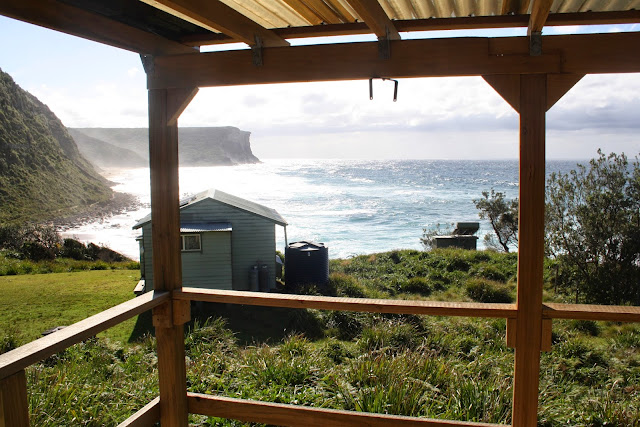
The glorious view from Garie Beach on our previous (much more temperate) visit.
We huddle against the wind and I make my introductions as my filial and social worlds collide, milling about a picnic table while we wait for all the attendees to arrive. We are surprised by how many people show up, perhaps a couple dozen: active middle-aged couples in hiking gear, a young migrant family with an adorable baby, and the various other pleasant, solitary grey-haired oddballs you find at such events, enthusing politely and asking earnest questions like garrulous mature-age students at uni. My friends and I are conspicuously the youngest adults there, later earning us the moniker of 'the young ones' from the event coordinator Kerry, who soon makes herself known and leads us on a narrow path towards Little Garie nestled between the cliffs on one side and the beach on the other.

Family: Nan, Eddie, and great aunt and uncle Christine and Stewart bringing up the rear. The 'most accessible' though it is, all the materials that comprise and fill the shacks of Little Garie would have to have been carried along this narrow path, including the heavy old kerosene fridges and cast-iron fireplaces.
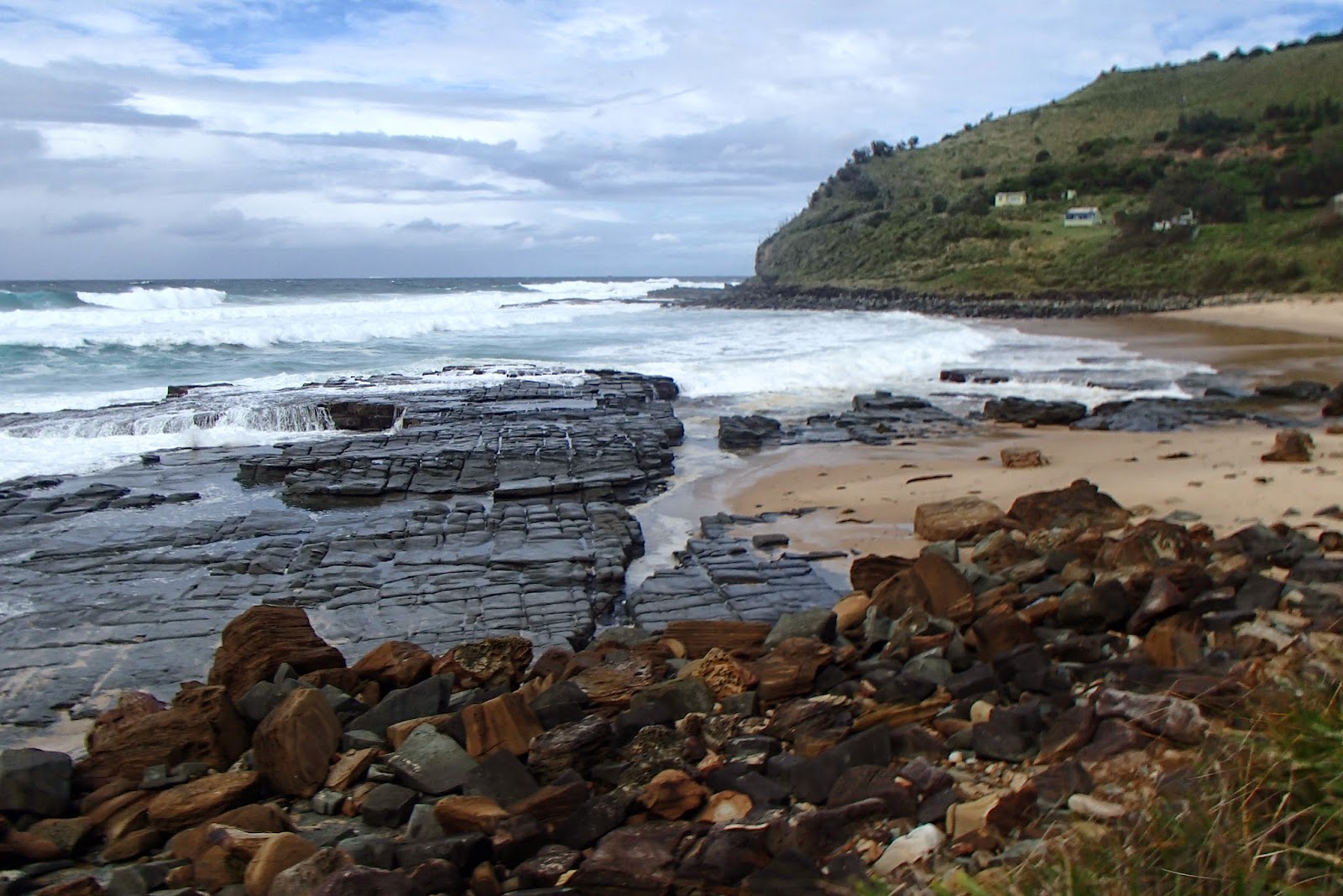
The view from the track, with the rocky plateau where the shackholders meet for elevensies in the foreground and some of the Little Garie shacks beyond.
Warm and quick to laugh, Kerry strikes me over the course of the day as the most socially conscious of the guides, trying visibly to keep speeches from her fellow guides on track, forewarning us of the more notoriously loquacious shackholders and hurrying along any groups that linger too long in any one dwelling. She guides us up a steep hill, which she assures us is the only one we will need to contend with, to the characterful Little Garie community hall and chapel, where we are to meet the rest of the guides and residents: Tim, Peter, James, Gary, Tony and more. I didn't take any photos on this occasion, but I did take some during the 2013 visit:


Kids playing with a kart outside the hall.
In the hall we learn that the first shacks in the area were holiday cabins built from 1910 onwards on land rented from the owners, forty years before its incorporation into the National Park. Later during the Depression, the communities swelled as unemployed miners from nearby Helensburgh moved into the area. Once the land was resumed in 1950 after lobbying from the shackowners to protect it from property developers, no new shacks were permitted to be built. The existing shacks could, however, still be bought and sold until the mid-1960s when the land came under the governance of the newly formed National Parks and Wildlife Service (NPWS), whose policy was to remove the shacks once their owners died. This led many families to just continue paying rent under the pretense that their deceased relative was now a decagenarian. Nevertheless, the NPWS succeeded in demolishing around 50 shacks during this time. Apparently the removal of the shacks ranked in the top two things former NSW premier Bob Carr wanted to get rid of during his time in office, during the same time heritage authorities were clamouring to protect them.
Today the shackholders are council workers, medicos, PhDs, engineers, sugarcane farmers, coal miners and all manner of other professions. Indeed, one of the most distinctive shacks we would see, brimming full of fantasy novels and half built of stones that leak when it rains, is cared for by a kindly Woolooware High School science teacher/archaeologist/Egyptologist. Each shackholder pays circa $3,000 a year in rent, and they are entitled to have up to four names on their leases. Very few of them live in the shacks fulltime, but they visit frequently on weekends and stay for long periods over summer and during winter holidays. The custodians of such a prized coastal idyll might be expected to guard their closed community jealously against outsiders, but the open day shows their attitudes to be the opposite. In fact, it is due to their efforts to the contrary, largely exercised through the Royal National Park Coastal Cabins Protection League (RNPCCPL), that the NPWS' policy of shack removal has latterly been overturned. The communities' demonstration and celebration of their unique cultural heritage has led to its recognition by several various heritage authorities, and the open day itself, we are told by bright, eloquent RNPCCPL president Helen Voysey, commemorates the listing of the communities on the State Heritage Register in 2012.
The promulgation of the shack communities' culture being one of the goals of the day, the shackholders are eager to impress upon us the importance of the shacks in their lives. 'We're very heartfelt. These aren't just some place we come and have fun, stresses Kerry. 'These are a part of our structure, our DNA.' She also emphasises the intimacy of the Little Garie community, noted among the four for its closeness, citing how quickly secrets spread among the shackholders, and their daily ritual of elevensies. Another community member adds that there are regularly five generations in a shack, and Helen concludes that 'Heritage is not just your big stone buildings and your government houses; it's your little shacks where people survived the Great Depression and where people carry on a kind of holiday recreation life.'
Another point to which the shackholders continually return is the effort involved in maintaining their seaside escapes. Possessed perhaps of an ingrained sensitivity from the parlous state in which the shacks existed for such a long time, they seem to want to prove that it's not all just the bucolic retreat and pleasant weekends surfing and fishing in the sun that visitors might think, that it's not only through the luck of birth or marriage that they come to enjoy their shacks, but that they have earned the privilege through their hard work preserving and maintaining them. Peter characterises the task as a fulltime job, battling the wind, storms, and vandalism. Their $3,000 a year is the price for the location alone; it doesn't buy them the amenities, roads, pathways, infrastructure the ordinary taxpayer expects, nor the community services ratepayers enjoy, nor the upkeep on which ordinary renters can depend. The shackholders seem to do most of this themselves. They constructed the stairway we trudged up to reach the hall, Kerry told us, when the NPWS wouldn't pay for it and visitors kept injuring themselves. My friends and I happened to be there that day on our previous trip as the men sweated, heaving rocks up from the river to sink into the earth as platforms to stand on. I even recognise some of the shackholders in the hall as the smiling faces of people who greeted us and wished us well as we passed through that day, giggling in their swimmers with champagne glasses in their hands.

Throughout the day we would be regaled with such tales of the shackholders' diligent ingenuity and resilience, from the construction of the stone shack from boulders rolled down from the hills above to its more recent repair when the roof blew off in one piece. Fences have been erected to prevent rockfalls and protect and hold back plant species. Days have been spent clearing the brush of the decades worth of shattered glass from the beer bottles of the shackholders' antecedents. An agreement was made for the community to take over the upkeep of any shack whose owner grew too old to maintain it themselves. And then there is the shacks' most persistent enemy: whiteants.

We are informed the floor we are standing on in the hall has just been replaced for fear that it wouldn't hold up underneath us after whiteants (or termites) had been at it. The first shack we are led to in our smaller group, in fact, is a thoroughly comfortable and modern-looking, caravan-style dwelling which owes its contemporary feel to its previous degradation by the voracious little insects. The shack belongs to Tony, a friendly bloke jokingly referred to as a 'blow-in' for his measly two decades in the community who was invited in when the former owner of his shack was no longer able to care for it and had no willing heir to take up the responsibility. Tony restored the shack and, in the process, added a few mod-cons. The internal bathroom is tiled, the walls are smooth and a TV plays a DVD about shack life in the background.



Today the shackholders are council workers, medicos, PhDs, engineers, sugarcane farmers, coal miners and all manner of other professions. Indeed, one of the most distinctive shacks we would see, brimming full of fantasy novels and half built of stones that leak when it rains, is cared for by a kindly Woolooware High School science teacher/archaeologist/Egyptologist. Each shackholder pays circa $3,000 a year in rent, and they are entitled to have up to four names on their leases. Very few of them live in the shacks fulltime, but they visit frequently on weekends and stay for long periods over summer and during winter holidays. The custodians of such a prized coastal idyll might be expected to guard their closed community jealously against outsiders, but the open day shows their attitudes to be the opposite. In fact, it is due to their efforts to the contrary, largely exercised through the Royal National Park Coastal Cabins Protection League (RNPCCPL), that the NPWS' policy of shack removal has latterly been overturned. The communities' demonstration and celebration of their unique cultural heritage has led to its recognition by several various heritage authorities, and the open day itself, we are told by bright, eloquent RNPCCPL president Helen Voysey, commemorates the listing of the communities on the State Heritage Register in 2012.
The promulgation of the shack communities' culture being one of the goals of the day, the shackholders are eager to impress upon us the importance of the shacks in their lives. 'We're very heartfelt. These aren't just some place we come and have fun, stresses Kerry. 'These are a part of our structure, our DNA.' She also emphasises the intimacy of the Little Garie community, noted among the four for its closeness, citing how quickly secrets spread among the shackholders, and their daily ritual of elevensies. Another community member adds that there are regularly five generations in a shack, and Helen concludes that 'Heritage is not just your big stone buildings and your government houses; it's your little shacks where people survived the Great Depression and where people carry on a kind of holiday recreation life.'
Another point to which the shackholders continually return is the effort involved in maintaining their seaside escapes. Possessed perhaps of an ingrained sensitivity from the parlous state in which the shacks existed for such a long time, they seem to want to prove that it's not all just the bucolic retreat and pleasant weekends surfing and fishing in the sun that visitors might think, that it's not only through the luck of birth or marriage that they come to enjoy their shacks, but that they have earned the privilege through their hard work preserving and maintaining them. Peter characterises the task as a fulltime job, battling the wind, storms, and vandalism. Their $3,000 a year is the price for the location alone; it doesn't buy them the amenities, roads, pathways, infrastructure the ordinary taxpayer expects, nor the community services ratepayers enjoy, nor the upkeep on which ordinary renters can depend. The shackholders seem to do most of this themselves. They constructed the stairway we trudged up to reach the hall, Kerry told us, when the NPWS wouldn't pay for it and visitors kept injuring themselves. My friends and I happened to be there that day on our previous trip as the men sweated, heaving rocks up from the river to sink into the earth as platforms to stand on. I even recognise some of the shackholders in the hall as the smiling faces of people who greeted us and wished us well as we passed through that day, giggling in their swimmers with champagne glasses in their hands.

One of the shackholders carries a stone up the hill to use in the construction of the stairs.
Throughout the day we would be regaled with such tales of the shackholders' diligent ingenuity and resilience, from the construction of the stone shack from boulders rolled down from the hills above to its more recent repair when the roof blew off in one piece. Fences have been erected to prevent rockfalls and protect and hold back plant species. Days have been spent clearing the brush of the decades worth of shattered glass from the beer bottles of the shackholders' antecedents. An agreement was made for the community to take over the upkeep of any shack whose owner grew too old to maintain it themselves. And then there is the shacks' most persistent enemy: whiteants.

Some of the shackowners of years past were more creative in their bottle disposal methods. Each of these show their brewing year on their base, some dating back to the forties and fifties.
We are informed the floor we are standing on in the hall has just been replaced for fear that it wouldn't hold up underneath us after whiteants (or termites) had been at it. The first shack we are led to in our smaller group, in fact, is a thoroughly comfortable and modern-looking, caravan-style dwelling which owes its contemporary feel to its previous degradation by the voracious little insects. The shack belongs to Tony, a friendly bloke jokingly referred to as a 'blow-in' for his measly two decades in the community who was invited in when the former owner of his shack was no longer able to care for it and had no willing heir to take up the responsibility. Tony restored the shack and, in the process, added a few mod-cons. The internal bathroom is tiled, the walls are smooth and a TV plays a DVD about shack life in the background.

Tony speaking to us in his 'beach shack'. Many of the shacks feature these little signs, which in another context might be considered tacky – cheap, mass-produced knick-knacks hawked by imitation-high end homeware stores to ironically adorn the holiday homes and beachside investment properties of affluent city-dwelling bourgeoisie. But somehow I think the shackholders are more entitled to make use of them than these usual purchasers.
The contemporary style of Tony's shack represents another theme that permeated the day. Kerry has encouraged us to ask questions of our guides, saying, 'They're passionate about their shacks and their ideas'. In the way of so many people who lead eccentric lifestyles, who harbour some desire to retreat from ordinary life, whether innate or bred into them by a lifetime of shack holidays, many of the shackholders seem to have eccentric or strongly held views. Of course, I only had a few hours contact with them, but even in that time I feel I was able to detect a few of these unguarded opinions, which seeped into the conversation at any opportunity, the way we vegetarians wait for any vague allusion to meat-consumption to pounce on. Kerry and the others hint laughingly a few times at the strife that arises between community members occasionally, as with any family, saying she thinks it's what makes them so close. One of the divisions I pick up on is between those who have updated their shacks and the purists who 'don't like the modernisation of the shacks' and prefer 'to keep them as humble as what they were when our parents had them', in Kerry's words.
Tony, I think, may be omitted from this mild resentment because his was a restoration of necessity, but when she takes us through her shack, passed down from her husband Gary's parents, Kerry remarks that some shacks even have Foxtel, adding, 'We ain't going down that path!' Later in the last shack we'll see we are astounded by the decorations. Books line every ledge and splay over every surface (I'm impressed by the presence of Winton and Dawkins). Entire walls are covered in patterns formed from wine corks, which seems a local fashion, while others are plastered with photos depicting festive evenings on the grog with not a few bared breasts and bottoms. Snake skins and cicada shells dangle from the rafters, dead sea animals hang in the windows, along with paraphernalia of every other kind scattered everywhere: a Navy sailor's hat that washed up on shore, artwork by the grandkids, ancient photo albums, a telescope. Awed as we enter, the owner says pointedly, 'Yeah. This is a shack. A real fisherman's shack', as if in distinction from the less authentic modern shacks that surround it.

This shack was the most exciting to me because my hermit protagonist's shack is similarly brimming with the objects he collects, and ideas were rich for the harvesting here.
All this conjures the image of a secret Little Garie cabin elite who behind closed doors thumb their noses at the unenlightened shackholders turning their abodes into the holiday-home equivalent of McMansions, and I tend to sympathise. Certainly the most unchanged old shacks are the most fascinating, both for my friends and me as a window into the past and as nostalgia for those of the older generation in attendance. Nan lights up when we enter one old shack with a hand-wound laundry wringer out front, still furnished in the old style within. Other people seem more interested in these older-style shacks as well – this shackholder proudly shows us the magazine article in which he featured, and Kerry tells me a Tropfest film was shot there last year.
Another strong and not-so-hidden view that pervades the community is a lingering contempt for the NPWS, understandable given the historical animosity between them. Helen describes the history as a pendulum swinging, and expresses a hope that one day it will eventually stop somewhere in the middle. At first the authorities liked the shacks, she says, because they wanted the revenue. Then the pendulum swung and the idea that national parks would be without people rose to prominence, before it swung back to recognise the value of human heritage. (It occurs to me that this is much more elegant and obvious metaphor for my 'stratigraphy of argumentation', which I later learned was an unconscious permutation of the Hegelian dialectic). Ever the PR liaison, Kerry speaks frankly about the rift but ends on a decidedly hopeful note, saying 'we're starting to get on an even footing now', only to be undercut by a more embittered community member who adds, 'Well, some of us are' in what is just one many veiled and unveiled digs at the (older) rangers and the NPWS throughout the day, and not without reason. In the hall after thanking us for our interest in the valley Kerry tells us it is 'important for us to get out our history, as in, the truth, let's say, not a skewed version.' We are told about one ranger who still works at the park who allegedly sunk an axe into a kerosene tank and, when asked why, reportedly answered 'So you bastards can't use it.' When bushfires swept through the region and the community evacuated, they came back to find the words 'Burn you bastards, burn' scrawled on their blackboard, supposedly by the same ranger.
The other strongly held beliefs of the community appear to be environmental. Kerry points out that the community has been forced to abandon their kerosene fridges for high-tech solar ones due to the unavailability of parts. We are introduced to at least one 'solar nut' and his solar-powered shack, as well as Peter, an affable 65-year veteran of the environmental movement, whose shack was one of the last legally bought Little Garie shacks . An engineering consultant by trade as well as a Landcare volunteer, Peter seems to be the resident historian of the community, claiming to have spent a lot of time researching to determine that the Royal National Park shacks are absolutely unique in Australia as non-road accessible coastal cabins built legally on freehold land. He distributes flyers about the communities entitled 'Living Heritage'.
Peter's experience of the environmental movement is fascinating. It must be bizarre to have been in a movement from its inception as a fringe concern and watch it ascend to mainstream acceptance. 'I can assure you it was not very popular,' he says in the hall. 'You were considered to be a Grade-A screaming nutter'. This is a pertinent example of our tendency to underestimate how much things can change in one lifetime, and a reminder not to measure the worth of ideas by their extremity in relation to the current norm, but on their own merits. In sixty-five years there will likely be an entirely new norm that may embrace what once seemed radical.

Peter's shack.

Peter.
Before Peter speaks in the hall we are jokingly warned not to ask him about climate change. He goes on to say that the environmental movement has been 'hijacked by radical nutters who really don't understand the issues'. He may have a point and his example of the protests against hazard reduction burning is hard to argue with, but I found myself hoping this friendly and knowledgeable figure wasn't a denier of anthropogenic climate change, although the warning not to ask him about it could be interpreted either way.
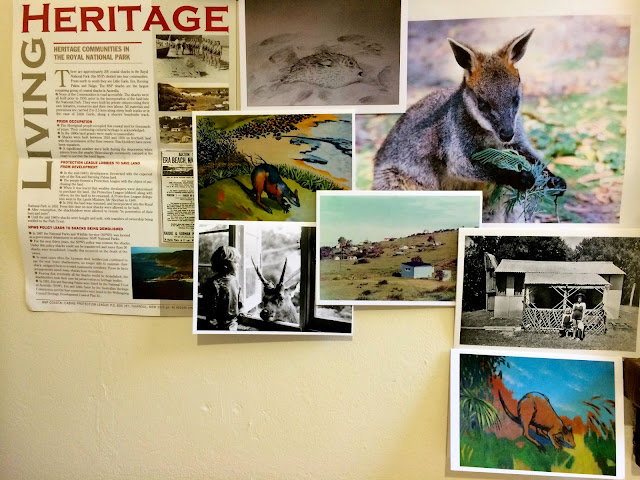
The tour over, the various smaller groups reconverge on the hall for the sausage sizzle the shackholders are putting on. Alexandra and I duck back to the car to retrieve our Eski full of a vegetarian feast and sit in the grass a short distance away, attracting gratifying comments from various passersby that they're jealous of our lunch. A Little Garien hawking raffle tickets offers me the 'lucky ticket' 69 (appropriately the one from the shack featuring the lewd photographs) and I purchase some giftcards featuring paintings, photographs and drawings by a local artist to add to the nascent wall collage next to my desk to inspire me. Meanwhile, Charlene prompts my nan to buy me a 'Shacks Forever' shirt by pretending I told her I really wanted one.

I thought myself lucky to find the two paintings of the swamp wallaby, as one significant section of my novel revolves around one such wallaby who lives in the park.
After that the weather finally gives out and the rain drives everyone back inside the community hall. Fearing that the locals would take issue with an outsider coming in to tell their story for them, I was hesitant to mention the novel to anyone. My nan, however, fearlessly informed both Kerry and Helen, who thankfully responded with nothing but polite enthusiasm, obligatory though that may. But I'm glad, because it got me both some tantalising traces of stories to follow up on, some regarding the real hermits who inhabit the national park, as well as some great contacts, especially Helen, who welcomed me to contact her when I needed more information, something I will definitely be doing when the time comes. I'll also, I'm sure, be making many more journeys to the National Park to continue learning about the extraordinary communities to be found in this place which is so central to the geography of my life. And maybe when I do, at Charlene's suggestion, I'll be wearing the shirt Nan got me.

Shacks forever!
Thanks for reading
LPL
Note: If anyone depicted visually or textually in this post wishes their name or image to be omitted, please contact me. Feel free also to contact me with any questions, corrections or complaints.


