Showing posts with label The Right. Show all posts

Friday, 11 April 2014

Book review: terry goodkind's chainfire

Friday 11 April 2014

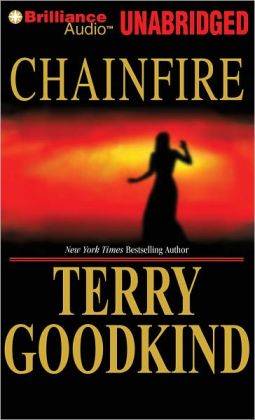
Following on from my discussion of audiobooks in my last post, 'Reading habits in the modern age', and considering the interest this review generated on Facebook when it cross-posted from Goodreads, I thought it was worth throwing up here as well. Stay tuned for more scathing reviews as I continue needlessly to torture myself with Goodkind's works until I'm all caught up ...


Deplorable Ayn Rand fanatic Terry Goodkind's sole plot device of separating hyperbolically perfect lovers Richard and Kahlan recurs yet again in Chainfire, if in a slightly more interesting incarnation this time, with the erasure of Kahlan from everybody's memories but Richard's. This results in some characteristically tedious, repetitive, unrealistic, interminable, eyeroll-inducing exchanges between Richard and other characters as he tries to convince them of his inevitable correctness against their insistence that he is deluded. Oh and also something about an invincible beast that (of course) horifically mutilates people to get to Richard. 

Goodkind has only my obsessive compulsion to finish what I start to thank for my continued consumption of his free market capitalist propaganda, and the fact that the books have been turned into audiobooks. I don't think I'd get through them if I had to will my eyes to continue relaying the derivative, uninspired words on the page to my brain instead of just tuning out and doing something else as the poor voice actor drones on and on, trying to intone the author's awkward phrases with any sense of realism. There are also, of course, the obligatory clumsy, transparent, desperate, deluded attempts from the author to trick the reader into endorsing morally untenable positions that glorify selfishness and pose helping others as the greatest kind of evil, as well as other philosophies that support a purely self-interested free market capitalist, minimal-government, nonexistent welfare dystopia. 

The book ends on a cliffhanger to propel you into the next book in the triology, and I have to admit despite my innumerable objections that I'm usually interested in what happens at the end of each book as events (finally) reach their climax. Anyway, I'm one book closer to catching up to Goodkind and hopefully not reading another book from him for many years to come (or ever again).

Thanks for reading

LPL

Wednesday, 14 August 2013

What's wrong with 'sex appeal'

Wednesday 14 August 2013


Opposition Leader Tony Abbott instigated a Twitterstorm yesterday when he listed 'sex appeal' as one of the assets shared by Fiona Scott and Jackie Kelly, the current and former Liberal candidates for the seat of Lindsay. Predictably, commenters and commentators of the Right, such as my own personal bête noir Miranda Devine, have since responded to the criticisms with lamentations about 'political correctness gone mad'* and 'confected outrage' and, of course, the usual deluge of abhorrent eructations from Andrew Bolt fans:

Comments from Bolt's readers, as tweeted by the good people at @BoltComments.

*I've previously discussed (and mounted a small defense of) political correctness here.

The point of this post isn't to condemn Tony Abbott, as condemnable as I think he is. Aside from his history of misogyny and his lack of expressed compunction I actually don't believe what he said is that personally reprehensible, just inappropriate and symptomatic of a larger issue. What I want to try and do is explain to those people inclined to agree with Devine, Bolt and company, why the Left finds the comment so objectionable. 

But first I want to address what's not wrong with the remark. Firstly, no one's claiming there was any malice in it. I think there's a common misconception that the lack of intention to offend excuses someone from having done so, as indicated by Opposition assistant treasury spokesman Mathias Corman's explanation that '[i]t was just a light-hearted comment, which I'm sure was not meant with any offence' (news.com.au). But this is an oversimplification. What this kind of thing reveals is not the speaker's unkindness or immorality, but rather their ignorance, often of how words, acts and omissions can reinforce cultural attitudes that privilege some and disadvantage others. 

Think of that disgusting 'Trayvoning' trend that's taken off recently, to much obloquy. Realistically, I'm sure most of the boys posing in those pictures are otherwise reasonably good people, who'd probably respond to criticism by saying it was all just a joke and they didn't mean any offence. Their wrongdoing is not a deliberate intent to mock a murder victim, but rather an unthinking insensitivity to a tragic and politicised issue and a grieving family, a selfish, immature transformation of a tragedy into a source of entertainment, posted thoughtlessly online.

To return to my personal holy text, David Mitchell's Cloud Atlas (or rather, the Twyker–Wachowski film adaptation), it puts me in mind of the casual, unintentional sexism spouted by smarmy would-be architect of a nuclear disaster Lloyd Hooks, as portrayed by Hugh Grant, to Halle Berry's Luisa Rey:

This kind of talk belongs in the '70s.

Secondly, I don't have an issue with the fact that Tony Abbott or anyone else has appraised Fiona Scott as possessing 'sex appeal', that anybody finds her attractive. Human beings are always going to find other human beings attractive, but there's a difference between thinking someone is attractive and saying it, and that distinction takes us to the heart of the issue.

As I said above, I find Abbott's comment inappropriate. Not deplorable, not opprobrious, not disgraceful, just inappropriate. Whatever Abbott thinks of Scott's and Kelly's physical appearances, it should not have been brought into the discussion of their merits as candidates. What business does anybody's attractiveness have in a list of their qualifications to represent an electorate? 

Abbott's comment doesn't show us that he's a cruel person who consciously believes women are inferior to men. What it does give us is a direct window into his worldview, a worldview he may not necessarily have that much control over (how much do any of us really decide our worldview?), but one that he nevertheless holds and must be judged by if he wants to be the leader of the country. It shows, unsurprisingly for a conservative of his generation, that at a fundamental and unconscious level, Abbott cannot see women in the same way he sees men. This attitude I am able to overlook in people of a certain age who grew up in a different era, the way we forgive our 'racist grandparents', but not in the leader of our country.

If you still disagree, just think about what it means that, when called upon to list some of the similarities of his female colleagues, which he must necessarily accept as an opportunity to list their assets, the first things that come to mind are their youth, 'feistiness' and sexual appeal. He's struggling in that video. As we all know from his comments about scripted and unscripted commitments, his conspicuous absence from interviews and television programs like Q&A (despite an open invitation) over the past few months, the 'suppository of wisdom' contretemps, and that 'bizarre 28 seconds of silence', Abbott isn't the best with impromptu speaking. You can tell he's grasping for positive adjectives in that video, buying time with a string of ums and ahs, and in the top three he comes out with is 'sex appeal', something that would never occur to him had he been speaking of men. Abbott himself knows this, as you can tell if you listen to him stressing the words 'smart' and 'hardworking' (proper qualities) when he's asked about it later, after he's had some time to think.

'Sex appeal' is the descriptor getting all the attention, but I'd argue the others weren't that flattering, either. 'Young', I'm sure, is supposed to connote enthusiasm and energy, but it's a dubious distinction if that's the primary positive similarity you share with your predecessor.

Then there's 'feisty', the suspect implications of which Elizabeth Reid Boyd has already discussed (I agree the word is condescending, with the suggestion that women have to be feisty in the big, rough boy's game of politics, but I completely reject the notion that its long-forgotten etymology has any impact on its meaning today).

Then comes 'sex appeal'. It's as though what Abbott wanted to say when the interviewer asked about the comparability of the two candidates was, 'Well, the similarity is obvious: they're both women ...' Would you ever say 'They're both men' in that situation? No, because maleness is the standard state of being, while muliebrity is a distinguishing condition to be remarked upon.

Even Abbott's final and most relevant compliment, that the two women are 'connected to the local area' reflects very little agency grammatically. They aren't active, agentive leaders in the community, prepared to make the tough calls and fight on behalf of the electorate. They're just passively 'connected' to the local area ...

I've seen Bolt commenters and others saying they've heard male politicians being referred to as sexy without any such backlash, but we rightfully hold our leaders to higher standards. Was it by a private citizen or media personality, or was it by someone holding high public office? Can you imagine Julia Gillard endorsing a local candidate in comparison to a predecessor by saying, 'They're both young, scrappy, and strappingly handsome'? I can't see it. What about Rebecca Shaw's example:

'It is unequivocally true that if Abbott had been asked a similar question about a male candidate, he would never say: “Well, um, well, Andrew Laming is young, feisty, has great hair and a very nice jawline”. If you are saying something about a female candidate that you would never say about a male candidate, you are treading on dangerous ground in the scary swamp of sexism.' (Shaw 2013)

We live in a society that consistently judges women by different standards to men (speaking of Julia Gillard), especially in terms of their appearance, a fact the Right fights against remedying at the worst of times and seems blind to at the best. The very fact that large segments of our society are held in the grip of an ideology that teaches them it is normal and natural to behave this way prevents their being able to see it. What the Left objects to about this incident is that it violates the principle that women in this day and age should be able to be enter the political sphere subject only to the same amount of attention to their physical appearance, whether positive or negative, as men are (i.e near none). The rules shouldn't suddenly change when it's a woman politician, so that it becomes a matter of public importance how she dresses, what she looks like, whether she's married or anything else. It's not so much what Abbott said, it's what his comment shows about him: that he is incapable of seeing the world in this way.

Thanks for reading

LPL
L Phillip Lucas (Facebook page)
@LPhillipLucas (Twitter profile)

References

Screenshot of Bolt Comments' (@BoltComments) twitter feed.

Amalgalmation of Simon Chillingworth's image and Warner Bros. Pictures' image.

News.com.au's 5:38pm AEST 14 August 2013 article 'Abbott cites exuberance in latest gaffe'.

Rebecca Shaw's 9:49am AEST 14 August 2013 The Guardian article 'Sexygate: how Tony Abbott should have complimented Fiona Scott'.

Tom Twyker, Andy Wachowski and Lana Wachowski's 2012 film Cloud Atlas.

Saturday, 10 August 2013

Murdoch, the market and the myth of consumer choice

EDIT: I received an email threatening me with a $1,350 (+GST) out of licence fee for using several NewsCorp front pages in the original version of this post, so I've now removed them. I thought they might be covered under the 'criticism and review' fair dealing exceptions, but wasn't in a position to look into it any further at that point. Wishing the guys at News Corp well in their continuing endeavour to pander to the masses, disregard all journalistic principle, capitalise on people's fears and erode democracy.

Saturday 10 August 2013

In a move that unexpectedly became the talk of Twitter this week, Wallabadah General Store owners Glen and Kim Sheluchin announced on Monday they would no longer stock News Corp papers, citing the company's 'blatant' and 'long-standing' political bias (Nickell 2013). Owned by Australian-born media tycoon Rupert Murdoch, the corporation's front pages have been devoid of any pretension to objectivity since Sunday's election date announcement, giving credence to Prime Minister Kevin Rudd's claim that editors have been instructed: '[G]o hard on Rudd, start from Sunday and don't back off' (Grattan 2013).

(Refer, for example to the Daily Telegraph frontpage from the 2013 election reading 'Finally, you now have the chance to ... KICK THIS MOB OUT' and the other featuring Photoshopped images of Craig Thomson, Kevin Rudd and Anthony Albanese as characters from Hogan's Heroes, accompanied by the caption 'THOMMO'S HEROES' and the headline 'Albo's explanation for German beers with Thomson: I KNOW NUTHINK!')

As I've mentioned in the past, I believe along with many others that the two arms of a functioning democracy are a robust media and rigorous universal education, so watching the descent of Murdoch's tabloids, especially The Daily Telegraph and The Courier-Mail, from populist mouthpieces to full-blown propaganda over the past few years has been extremely disturbing. It was only in 2010 on my first trip to Britain when I encountered the shameless (and shamefully popular) likes of The Sun (News Corp) and The Daily Mail (DMGT) that I thanked heaven the media discourse in Australia was not so woeful,* that you'd never see such openly biased headlines here. It seems I was wrong to put it down to anything more than antipodean backwardness: we've finally caught up.

*Of course, at this time, I'd never yet seen an edition of the NT News (News Corp), which is known for its outrageous headlines (see the edition featuring an image of a shirtless man drinking a beer with a snake coiled around it accompanied by the headline 'WHY I STUCK A CRACKER UP MY CLACKER').

I first became alarmed in early 2012 while on a business trip in Brisbane. There the political temperature allowed The Courier-Mail to trumpet anti-Gillard sentiment in a way I suspect no other state (excepting perhaps Western Australia) would have tolerated at the time, stirring up even more of the public vitriol demonstrated when local colleagues would whip around in their chairs at the mere mention of the PM, ready to criticise the way she spoke or dressed at any opportunity.

The Sheluchins may have already overturned their ban after a smarmy diplomatic mission by the Tele (discussed in all its quease-making detail here), but hearteningly, not before they received a deluge of 'calls and messages of support' (Nickell 2013) and inspired other vendors to follow suit. The management of Brisbane's Slightly Twisted Refreshment Lounge, for example, which never sold the paper but had it available for customers to read, revealed on Twitter yesterday that they're now displaying this sign in-store:


But there have of course been negative responses to these small business boycotts, most of them bizarrely labelling them acts of 'censorship' (a term the Tele was more than happy to throw around in the gloating victory speech linked to above). For example:



This, of course, is nonsense. As I pointed out on Twitter, the argument is essentially that a newspaper's existence demands its supply or else it's censorship. The Sheluchins said themselves they don't stock Fairfax's The Financial Review. Presumably they don't sell Green-Left Weekly or Uganda's Daily Monitor, either. Censorship? Of course not. The difference, some might argue, is that there's an established demand for the Tele, but I'm afraid there's still that much-vaunted principle at the heart of capitalism to contend with: choice. There might also be a demand for child pornography or cocaine, or even cigarettes. That doesn't make it 'censorship' to refuse to sell them because of your 'own personal political views' that child pornography/cocaine/cigarettes are unethical.

Because unfortunately, that's what capitalism does to truth: commodifies it. The newspaper is a product like any other, and if the vendor of that product decides it is of substandard quality, they are free to cease selling it, and their customers are free to shop elsewhere if they don't like it.

It's curious the disproportionate amount of concern the objectors seem to have about this one supposed form of obfuscation of the truth through 'censorship' in comparison to the potential obfuscation of the truth Murdoch's papers might have through, say, shoddy journalism, liesdubious ethics, bias, editorial influence, vested interests and market monopoly (as the management of the Slightly Twisted Refreshment Lounge noted, 'there are no local publications not controlled by Mr Murdoch' in their area; what does that say about the influence of one man over an entire community?)

Here is one of the multifarious failings of capitalism: it's as though in its animalistic mimicry of the system of evolution (competition, survival of the fittest, etc.), it has also taken on Freud's eros drive, that biological urge 'to combine organic substances into ever greater unities' (1920, page 50), realised in the inescapable corporate gravitation towards monopoly, the ineluctable upward accumulation of wealth and power. 'He's earned his influence', free marketeers, Libertarians and minarchists will protest. 'He's powerful and wealthy because his papers are popular!' Truth by popularity. 

Which is what's so strange about these objections: they controvert the basis of the Right's usual disagreement with 'regulations' and 'red tape' and 'big government', that one golden principle I referred to earlier which it mistakenly apotheosises as the way to determine all truth and quality and morality: consumer choice. As far as I can see, these News Corp boycotts are one of the few examples of consumer choice actually working as it is supposed to. Every time the quality or ethics of a product is questioned and the suggestion of more regulation is proposed, the Right turns to the touchstone of consumer choice: 'We don't need big government interference – the consumers are our regulators. If consumers don't believe what Rupert Murdoch's papers say, they won't read them ... If consumers don't like the way cage eggs are produced, they won't buy them ... If consumers think reality television is vacuous fluff, they won't watch it.' 

Under capitalism, your dollar is your vote, and (in the fantasies of Randists) the market is supposed to adjust itself to align with consumer opinion as businesses consumers like succeed while businesses they don't fail. As though we are all moral philosophers, thoroughly conscious of the ethical ramifications of our every purchase. As though we have the time in our busy lives to research whether every product we buy is tested on animals or contributes to the deforestation of the Amazon or is made by third-world child sweatshop labourers working eighteen hour days for infinitesimal pay. As though in the moments before we put each item into our trolleys, bombarded by psychologically manipulative advertising and marketing and packaging designed to conceal anything untoward, dogged by a hundred other disparate velleities and cravings and distractions and concerns, we are our best rational and ethical decision-making selves. As though the majority of us are even concerned with right and wrong when we are shopping. As though we haven't been taught that the only value worth considering is monetary value. As though most of us even have the ethical fortitude to resist purchasing products we know involve unethical practices. This system is demonstrably flawed.

So here, in the form of a few small business owners rejecting the low-quality products of a powerful multinational corporation which will probably get its own chapter when historians write about the downfall of the United States (notoriously evil American television network Fox News, panderer to climate change deniers, Creationists, second-amendment nutjobs, Tea Partiers, Republicans and other fundamentalists, is also Murdoch's handiwork), we have one rare instance of an actual deployment of consumer choice for a reason other than price, one time where the consumer has looked at a substandard product and said, 'No, this isn't good enough; I refuse to sell this', and the internet commenters of the Right denounce it.

Jeff Sparrow, editor of left-wing literary journal Overland, is optimistic about the recent slew of rubbish front pages from The Daily Telegraph, and claims the reaction to them online is a signal that 'Murdoch's spell is breaking' (2013). But it's easy to convince yourself you're in the majority when you're surrounded by sympathisers, when you're caught up in the outrage of the Twitter intelligentsia. Growing up in the safe Labor seat of Throsby I'd never met anyone who voted Liberal and couldn't even imagine anyone voting for Howard, and yet he'd won every election in my lifetime until '07. I'm sure Sparrow has the deductive powers to see past those in his immediate political surrounds; I just can't share his optimism in this.

Besides, it's not the engaged people I'm worried about. Not the ones who spend time reflecting on these issues, reading political articles, tweeting their outrage, and slowly constructing a worldview from a number of sources like world news from other countries, independent media, books, discussion, Q&A and Lateline. It's the ones who can't be bothered with politics most of the time, the reluctant voters, the uninformed but stubbornly opinionated who concern me. The ones who glean their political views incidentally from here and there: the mainstream news, the Sunday paper, what other people seem to be saying, a bit of Alan Jones here, a bit of The Bolt Report there. Because when you don't seize control of the discourse, when you just cruise through your intellectual life on autopilot receiving whatever comes your way, the vested interests take control for you, and you've got nothing against which to contextualise your information. The chances are that the vast majority of news these 'uninformed opinionated' come into contact with is produced by the Murdoch media and they don't even know.

So I think Sparrow might be giving people a little too much credit. People don't want facts and truth and expert opinions from people smarter or more specialised than them. They don't want hard questions about right and wrong that might require them to change their behaviour. They want entertainment. They want fluff. And 'consumer choice' on its own without any other barometers of quality or truth usually ensures they get it. Consumer choice alone results in pandering, like a divorced glory parent who only takes their child on weekends and spoils them with gifts and sweets and amusement parks instead of necessities and vegetables and homework, making the other parent seem boring. Given the choice, who might the child prefer to live with? What lifestyle would they choose to adopt? Do they want to watch Big Brother or Lateline? Do they want to read celebrity gossip or serious policy discussion?

This is why it would've been useful to have a real media inquiry in this country. But the howls of 'freedom of the press' that issued from the papers, accompanied dutifully by the Coalition, saw the death of that. You might disagree it was needed, but let's just imagine that it was. One wonders how we would ever get such an inquiry given the corrupt media would use its opinion-forming power to turn public sentiment in its favour with whichever party was in opposition to give it credibility.

No, my feeling is that we're stuck with tabloids that will become ever more like Britain's now, at least as long as the newspaper format survives. All we can do is try to avoid ending up with the Australian equivalent of Fox News that we already know prominent conservatives and conservative organisations like 'Lord' Monckton and the IPA are gunning for. And, of course, to save the ABC from privatisation or, in other words, dumbing it down as much as the commercial networks. I only pray it doesn't come to that.

Thanks for reading

LPL
L Phillip Lucas (Facebook page)
@LPhillipLucas (Twitter profile)

References

The Daily Telegraph's Monday 5 and Thusday 8 August 2013 front pages.

Harry Dellavega's (@NastyHarry) 9:11am 9 August 2013 Twitter tweet.

'Didie's' comment on Ms Alena Nickell's 4am Friday 9 August 2013 The Northern Daily article ''Be fair or you'll be binned''.

Sigmund Freud's 1920 book Beyond the Pleasure Principle in Volume 18 of James Strachey's 1953 –1974 series The Standard Edition of the Complete Psychological Works of Sigmund Freud, published by Hogarth Press, London.


NT News's Tuesday 31 July 2012 front page.

Alena Nickell's 4am Friday 9 August 2013 The Northern Daily article ''Be fair or you'll be binned''.


Slightly Twisted Refresment Lounge's (@Sl1ghtlyTw1sted) 8:23am Friday 9 August Twitter tweet.

Monday, 16 April 2012

Cloud atlas and the left

Monday 16 April 2012

I'm quite short of time at the moment (one assessment due tomorrow, one on Thursday, three books to read this week, editing work needed for Wednesday, going to Melbourne for the comedy festival from Thursday to Monday, with a presentation on a book I haven't started reading due two days after I get back), so in lieu of a real post, here's something I've been meaning to put up here for a while that won't eat too much into my time.

A while ago, while Til and I were travelling around Italy and Greece, I read a wonderful book by David Mitchell called Cloud Atlas, which was shortlisted for the Booker Prize in 2004 and which was recommended to me by one of my lecturers, the excellent Dr Joshua Lobb.


I'm increasingly interested at the moment in tracing back the texts and ideas I encountered that led me to certain conclusions, because sometimes my conclusions (eg socialism, vegetarianism) seem so radical when just looked at bare. But if I could present people with a more manageable sequence of ideas that, once accepted, lead to that conclusion, it might be more understandable.

The book is full of beauty and poignancy, but in particular the passage I want to quote below, the ending of the book, when read after undertaking the journey of the entire novel, was one of the first things I encountered that led me to start thinking about why a progressive, leftist, socialist (look it up if that sounds alarming; it might not mean what you think it means) approach to world governance is a better one than a conservative, capitalist, individualist one. I now see the divide between left and right as largely one of cooperative socialism and competitive individualism. It even had a part to play in the development of my ideas about vegetarianism (note the 'weaselly word' the narrator identifies, and possibly see my post ''Naturalness', semantic decay and veg(etari)anism (part two of three)').


And don't worry, it doesn't have much in the way of spoilers, although being the final passage there are a few references you obviously won't understand if you haven't read the book:

Scholars discern motions in history & formulate these motions into rules that govern the rises & falls of civilizations. My belief runs contrary, however. To wit: history admits no rules; only outcomes. What precipitates outcomes? Vicious acts & virtuous acts.

What precipitates acts? Belief.

Belief is both prize & battlefield, within the mind & in the mind's mirror, the world. If we believe humanity is a ladder of tribes, a colosseum of confrontation, exploitation & beastiality, such a humanity is surely brought into being, & history's Horroxes, Boerhaaves & Gooses shall prevail. You & I, the moneyed, the privileged, the fortunate, shall not fare so badly in this world, provided our luck holds. What of it if our consciences itch? Why underminde the dominance of our race, our gunships, our heritage & our legacy? Why fight the 'natural' (oh, weaselly word!) order of things?

Why? Because of this: – one fine day, a purely predatory world shall consume itself. Yes, the devil shall take the hindmost until the foremost is the hindmost. In an individual, selfishness uglifies the soul; for the human species, selfishness is extinction.

Is this the entropy written within our nature?

If we believe that humanity may transcend tooth & claw, if we believe divers races & creeds can share this world as peacably as the orphans share their candlenut tree, if we believe leaders must be just, violence muzzled, power accountable & the riches of the Earth and its Oceans shared equitably, such a world will come to pass. I am not deceived. It is the hardest of worlds to make real. Tortuous advances won over generations can be lost by a single stroke of a myopic president's pen or a vainglorious general's sword.

A life spent shaping a world I want Jackson to inherit, not one I fear Jackson shall inherit, this strikes me as a life worth the living. Upon my return to San Francisco, I shall pledge myself to the Abolitionist cause, because I owe my life to a self-freed slave & because I must begin somewhere.

I hear my father-in-law's response. 'Oho, fine, Whiggish sentiments, Adam. But don't tell me about justice! Ride to Tennessee on an ass & convince the red-necks that they are merely white-washed negroes & their negroes are black-washed Whites! Sail to the Old World, tell 'em their imperial slaves' rights are as inalienable as the Queen of Belgium's! Oh, you'll grow hoarse, poor & grey in caucuses! You'll be spat on, shot at, lynched, pacified with medals, spurned by backwoodsmen! Crucified! Naïve, dreaming Adam. He who would do battle with the many-headed Hydra of human nature must pay a world of pain & his family must pay it along with him! & only as you gasp your dying breath shall you understand, your life amounted to no more than one drop in a limitless ocean!'

Yet what is any ocean but a multitude of drops? (527–529)

Incidentally, there's a film adaptation of Cloud Atlas coming out late this year with Tom Hanks, Halle Berry, Hugo Weaving, Susan Sarandon, Jim Broadbent, Hugh Grant and Jim Sturgess, so get your hands on a copy and read it beforehand!

LPL

References
David Mitchell's novel Cloud Atlas, published in 2003.

Cover image.